


Every so often, people are born who create a wave which ripples through the creative world, crossing generations in the process. David Bowie was one such man; a crazy, creative genius who had the talent and foresight to translate the abstract ideas in his head into real, theatrical performances and movements, changing the face of music and popular culture in the process.
Bowie was an innovator and a risk taker at a time when Britain was still coy and conservative, struggling to create a real post war identity for itself both in terms of popular culture and society at large. Bowie’s rise to prominence in the early 1970’s coincided with a time of hardship, national depression and daily struggle. For many people, David Bowie’s brave attempts to subvert traditional ideas of gender and sexual identity were a genuine light at the end of a very dark tunnel, a tunnel where the train of cultural progress had ground to a stuttering halt some time ago.
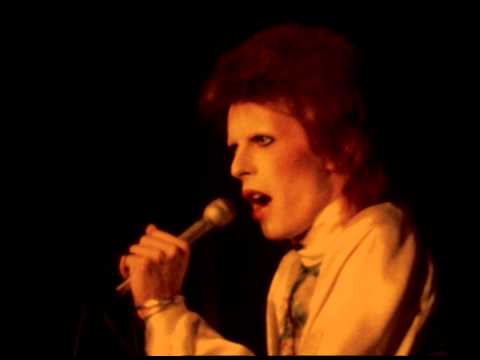
Of course, being disruptive and challenging in this way also drew a lot of savage criticism. Many deeply conservative commentators mocked what they saw as his completely OTT effeminate characteristics. He was not a man and couldn’t be further from traditional masculinity if he tried. But many spectacularly missed the point of what Bowie was aiming for. He was an actor playing a role, as much as he was a musician inhabiting the stage. He created personas like Ziggy Stardust to prove that it wasn’t about him (David Bowie) being a rock n’ roll star at all. After all, he sings:
Ziggy played guitar
With Weird and Gilly,
And the spiders from Mars

The persona of Ziggy was carried along by Bowie’s creative vision and when that vision no longer served a purpose he symbolically “killed” him off in a mock assassination, leaving him free to create another musical persona to give to the people.
Soon, however, Bowie became the persona; the musician, the artist, the rock n roll star. By the mid 1970’s Bowie had become established enough to feel comfortable in exploring who he really was in this newly inherited role – determined to be free of the damaging affects of his drug and alcohol use. This famous Berlin period coincided with some of the greatest works he produced: resulting in the albums Low, Heroes and Lodger. All of these albums are highly regarded by both fans and music critics alike. His association with the city of Berlin also had the result of raising its artistic profile, and this reputation remains firmly intact to this day. Berlin was always a culturally rich city but sometimes it takes a conjunction of events and the ripples of a certain time and place to enhance the perception of what a city really is.

Much has been written in detail about Bowie’s music and I don’t want to dwell too much on that, except to say that it is very rare that an artist has the creative intelligence and foresight to not only stay relevant culturally but also stay ahead of the curve in many ways. On social media, after his death, many contemporary artists have come out to say how much listening to Bowie in their formative years influenced them as musicians and inspired them to dedicate themselves to music as a career and a life. This is unsurprising really as Bowie had that strong persona which resulted in him being portrayed as more than just a musician, but, as I have alluded to, an artist, a cultural signifier, a movement in himself. He was a well read and highly intelligent man who took a lot of what he consumed and disseminated it throughout his work, often in a challenging and provocative manner, especially during the first half of his career. Later on, as he matured and aged, so did his music, it became more reflective, more personal and introspective. Yet he was still a keen student and follower of contemporary trends in both music and art. He applied his unique, chameleon like gifts to make sure his music sounded completely grounded in the zeitgeist; never dated and most importantly of all, never fake.
Bowie has spoken of certain periods of his career as being less “inspiring” than others. In particular, he has referred to the new romantic sounds of the early to mid 80s as one of his less favourite times as an artist. And yet, listening to works such as Modern Love and Let’s Dance from this period reminds me that, despite his own misgivings, these are still great songs. And it is a credit to his skill as an artist that even his bad works are still on a level which is higher than a lot of his contemporaries.

David Bowie’s final gift to the world was the album Blackstar. An impressive mish-mash of different musical styles from jazz to funk and traditional pop, laden with rich, dark and highly portentous lyrics pointing at his own acceptance of the end that was drawing ever nearer. Listening to the album is a difficult experience but, like a lot of his work, the more time you give it the more it reveals itself to you.
David Bowie will be remembered as a Citizen Extraordinaire – one of those one in a million people who are born to do great things, in his case challenge the tired pop culture establishment by rewriting the rule book, then throwing it away and doing his own unique thing. Time and time again we watched as he tried to progress and develop his talent, break down the norms and create something new. While he didn’t always succeed as an artist he left the world with a valuable gift; namely the ability to see that anything was possible and, if it was possible, it was worth trying.