


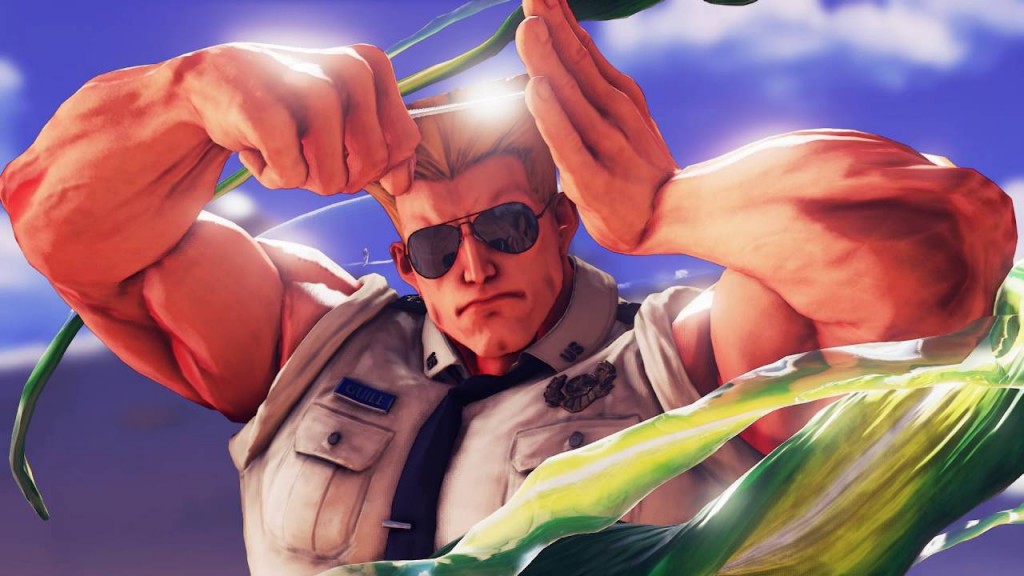
Guile for SFV became available in late April, and on the 29th I got the chance to take a look at his moves. I was never a great fan of the character in earlier games; I always liked to be doing things rather than sitting in the corner charging special moves, and this didn’t bode well when I was faced with opponents who used Guile. Even so, I was hopeful that Guile for SFV would have interesting tweaks and additions to his moveset – courtesy of the game’s V-System – and so once I had applied the necessary updates I tested him out in training mode.
Guile for SFV – versus Nash

One of the first things I was interested to find out was how Guile compared to Nash, as they both share similar moves and haven’t been in the same game since the Alpha series. Predictably, Guile for SFV has a Sonic Boom that looks like it behaves just like Nash’s, although as you’d expect it’s a charge input (requiring the player to hold back before pushing forward & the attack button simultaneously) whereas Nash’s is a motion input (a quarter-circle rotation). All three strengths of Sonic Boom push the opponent back a little, just like Nash’s projectile.
Guile for SFV also has his classic Flash Kick, and in matches it requires him to move forward a little when landing rather than staying in a stationery position. In a way it’s a lot like a reverse version of Nash’s Moonsault Kick – I tried recording Nash performing repeated Moonsault Kicks whilst I did Flash Kicks and the hitboxes and slight forward movement on both is interesting to compare. I imagine the fact that Guile for SFV performs his Flash Kick instantly will be useful when players want to quickly punish jump-ins, whereas Nash’s Moonsault Kick is more deceptive in that it doesn’t come out until he’s in the air, and you can dash under it if you’re close enough.
Guile for SFV – critical art and V-system

Additionally, Guile’s Critical Art – “Sonic Hurricane” – is fairly similar to the SFIV version, and is the first SFV Critical Art to require the classic super motion of charge characters – hold back, then quickly move forward, back and forward again before hitting the attack to execute the super. It’s a stationery obstacle with a wide hitbox and looks like it will be useful for catching players falling to earth or trying to close the distance.
However, Guile for SFV stands out from Nash and older iterations of Guile when his V-System abilities are put to use. The “Sonic Blade” V-Skill creates a stationery ball of energy, and if Guile throws a Sonic Boom through this ball of energy, the Sonic Boom transforms from the thin oval we’re all familiar with to a much taller projectile – a “Sonic Cross” – that does 2 hits, knocks the opponent down and is probably harder to jump over when under pressure. Since Sonic Booms are charged, however, this means that you ideally want to charge a Sonic Boom before throwing out the Sonic Blade.
If that didn’t sound novel enough, the V-Trigger “Sonic Break” transforms the projectiles available to Guile for SFV. Rather than holding back to charge Sonic Booms, Guile for SFV can activate his V-Trigger and then press both heavy attacks again to throw out a projectile instantly. Depending on whether Guile is moving forward, back or standing still when throwing the projectile, it will vary in speed, and each time a projectile is thrown, part of the already-depleting V-Gauge will lose a chunk of meter.
Guile for SFV – combo trials and summary

Before finishing these notes I had a quick look at his combo trials – they start with jumping normals into crouching normals and Flash Kicks (so you have to charge the Flash Kick immediately after jumping) and later ask you to land a crush counter hit and then charge and release a Sonic Boom whilst the opponent is still recovering, or begin a combo from a jump that ends with a Sonic Boom into the Critical Art.
I’m confident that a lot of Guile fans will be happy with this newer version of the character – his special moves and critical art are things that are comforting in their familiarity, and the V-System offers a bunch of new toys that make Guile for SFV a formidable opponent. In addition, it’s reassuring to note that the DLC is keeping to its monthly schedule, with Guile arriving in the last week of April after Alex had arrived in the last week of March. Hopefully this release schedule, combined with the quality of characters seen so far, will make Street Fighter V a game worth coming back to again and again.

Guile for SFV is available to download this month. Why not get an introduction to Guile for SFV by visiting his official character page or watching the character trailer on YouTube.