For those of us that like to prance around our living rooms pretending to be David Bowie, the last few years in gaming have felt a little bit like the Monday after a music festival. The party’s over and all that’s left to do is to look despondently at the crap that’s left behind before listlessly packing it away. ‘What was I thinking?’ you say to yourself, with little more to show for the moments of excess than an empty space where your money used to be.
Much like a weekend in a muddy field, Rock Band and Guitar Hero packed their spell in the spotlight with so much music that the end was inevitable; there was no way you could keep it up. Between the years of 2007 and 2010 they released over twenty different games between them. Harmonix’ game always came out as the critic’s darling; perhaps thanks to the developers influence in creating this sub-genre or perhaps down to Activision’s image as the risk-adverse mega-corporation; but what’s interesting about this year’s revival is that the perception of the two brands appears to have been turned on its head.
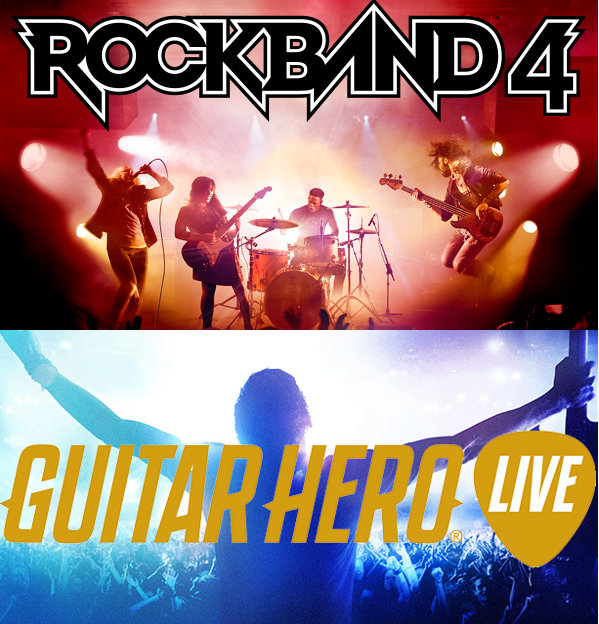
The differences in approach were made apparent from the off. Rock Band 4 was to be a platform on the newer machines that gave you access to your previously owned tracks and offered backwards compatibility with existing instruments. It looked the same and it played the same. Given that the genre had hardly moved since the first time we played out our rock star fantasies this plan seemed the most rational idea, even if ensuring they kept their promises on legacy content was certain to be a logistical nightmare.
Guitar Hero on the other hand, was going to throw the television out of the hotel room window taking all your existing music and plastic tat with it. A new guitar with new note placements, a streaming music channel approach to DLC and that most scorned of art designs, live action visuals, all suggest a clean slate. Being a cynical sort my initial reaction was that this was an attempt to sell you everything all over again but having spent some considerable time with the finished product it seems like possibly, just possibly, they had artistic intentions after all.
Guitar Hero’s two rows of three buttons feel delightfully different from the one row of five that we have become accustomed to. At times, when you’re positioning your fingers across both rows with your hand arched in a chord-like position, it feels fractionally more like you’re playing an actual guitar. Having played hundreds of hours in the older layout it’s difficult to say definitively if the extra button brings extra difficulty, but what I have found is that I’m occasionally glancing at the neck of the guitar to get my hands where they need to be; which is something I’ve never felt the need to do in Rock Band. Saying that one or the other is better would be premature at this stage (particularly as I’m yet to make the leap to Expert on Guitar Hero) but the change is refreshing and for the solo guitarist the attraction of a new challenge is difficult to resist.
Sharing with friends:
But for those of you in a band, the situation becomes a little more complicated. Guitar Hero has options for two player and microphone support but it feels somewhat tacked on while Rock Band is as gloriously inclusive as ever. There can be few experiences in gaming that achieve the same spirit of camaraderie as a full complement of musicians absolutely nailing a song. It’s a rare example of co-op where the goal isn’t to destroy but to create something beautiful together and yet it still retains the intensity of more traditional genres. To remove this entirely, which for many players will be the core of the experience, is risky and you suspect it was driven by the decision to go with live action, first person visuals.
The most obviously apparent of the changes to the Guitar Hero format, filming the entire process from the guitarist’s eyes, fluctuates between the sublime and the ridiculous on a second by second basis. Your bandmates, with their high-fives, overly earnest nods and near psychotic flirting, are all a little too clinical and clean to be convincing and in the crowd the cheese levels are through the roof with some truly cringe inducing banners (‘I’m proud of you!’ being a personal favourite – thanks Mum). But when you’re in the zone and a neat camera sweep fuses perfectly with the music it can feel somewhat magical. FreeStyle have packed the mini-movies with a number of neat surprises, in-jokes and references and when it works it works very well indeed.
Compare this level of consideration to Rock Band 4, which has a bafflingly stripped back suite of character customisation and stage options, and it quickly becomes obvious which game has received the most care and attention. The Harmonix series has always looked distinctive; chunky and elastic with a wicked glint in its eye; but the latest feels rushed and unfinished like they’ve done the absolute bare minimum to scrape by into acceptability.
Guitar Hero puts the band back together
These touches are small in the grand scheme of things, but they do add up. The lack of a custom set list option strikes me as the kind of thing that some poor soul realised they forgot to put in with a month or two to go and the lack of online multiplayer has proven to be a bigger sticking point than they perhaps expected. Putting on my tinfoil hat for a moment, it seems that the developers caught wind that Guitar Hero was making a comeback and hastily put something out of the door to ensure that they didn’t miss the boat. The fact that in the name of ‘streamlining’ keyboard and pro guitar support hasn’t made the cut supports this theory and it’s tragic that a series famous for lavishing love and attention on its fans seems to have turned its back on them for a quick buck.
This reaches its absolute nadir with the promise of backwards compatibility with all your tracks. I’m playing on PS4 and I’m lead to believe that the process has been painfully slow but workable for those players going from 360 to the One, but for me it just hasn’t worked full stop. Whole swathes of tracks are missing and those that I can find often return errors when I try to download them. This may be down to the notoriously incompetent team at PSN Europe but the fact remains that this game was sold to me on the idea that I would be able to play my old tracks and I can’t. I can’t shake the nagging sensation that I’ve been taken advantage of and lumbered with a £50 disc that doesn’t do what it’s supposed to do. To say that this has left a bitter taste in my mouth is quite the understatement.
Easy as DLC
And it’s here that the treatment of the audience from the two different companies starts to feel a little odd. While Harmonix have promised something they seemingly can’t deliver, Live’s approach to DLC, the streaming video service called Guitar Hero TV is ludicrously generous. The service currently has well over a hundred tracks which can either be accessed whilst the song is ‘on’ the channel or by using passes to pick and choose which songs you’d like to play. Passes can be bought for with in game currency, real cash or there is a £3.99 option that allows you to access everything for 24 hours. Now, This may well get your microtransaction sense tingling, but the rate at which the game hands out passes for free means that unless you’re really picky about which music you want to play you’ll probably never run out. It’s odd; it seems like almost too good a deal and I’m expecting to be ripped off by the cackling Activision suits at any moment. But so far, nearly thirty hours in, that moment is yet to arrive.
From Rock Band to Guitar Hero
What on Earth has happened here? The trailblazing, lovable, boutique developer responsible for nearly every major innovation in rhythm action over the last fifteen years have chucked out a half-finished, stripped-back, innovation free cash grab. Whilst the looming, lightening-illuminated, black tower of all-conquering Activision has produced one of the bravest and most generous reboots I can think of. When compared to other games in the series, particularly to the carefully considered, gracious labour of love that was The Beatles Rock Band and to the unfathomably deep and lavish Rock Band 3, 4 comes up woefully short. Guitar Hero Live is jumping up and down to be noticed with new options and mechanics while Rock Band 4 has limped onto the shelves with huge chunks taken away.
When I consigned my PS3 to the loft I lost a large portion of what gaming had come to mean to me. It was a way of fooling my brain, however briefly, that I was a talented and successful musician. For years Rock Band was a permanent fixture in my gaming schedule and its DLC a permanent mark on my bank statement. I spent way more on the Amplitude Kickstarter than can be reasonably justified. But since the release of Guitar Hero Live I’ve barely touched Rock Band 4. I just hope that this misstep doesn’t mark the death knell for a developer that has been responsible for some of my greatest gaming memories. For those of us that like to prance around our living rooms pretending to be David Bowie, part of the attraction is the constant reinvention; the quest to remain relevant. In which case, the choice of game is somewhat surprising this year.