Around May of 2022 I wrote a retrospective article about Final Fantasy V, the Super Famicom RPG that didn’t make it to our shores until the 2000s but boasted an impressive job system that inspires creative combinations of skills. I had always wanted to play a few of the early “pixel” RPGs in the Final Fantasy series, and since publishing that article I’ve played five of the first six games (I’m sorry, but you can’t make me play FFII.) However, a few of the newer games had also piqued my curiosity, and I’m long overdue an opportunity to share my thoughts on Final Fantasy XV. Released in 2016, it was a game I ignored initially but was still fascinated by – it features one of the least fantastical openings yet (with your party pushing a car across the open road as the camera pulls back), and gameplay so counter-intuitive that I feel like my decades of traditional series knowledge were being actively sabotaged. I firmly believe that the counter-intuitive design is what kept me coming back to the game in an effort to “understand” it – like 2010’s Nier, it’s a game where you have to discard your subconscious comparisons to any company you think it shares in its genre, and embrace XV as its own weird thing.
Subverting expectations

How about an RPG where your party doesn’t immediately gain experience after each battle? Instead, it’s tallied up at rest points and often results in a satisfying series of consecutive level-ups when it happens. Or what about the fact that money isn’t earned through battles, but only through selling valuables and completing select optional encounters such as the bounties posted up in towns? (This did lead to an amusing realisation when I was struggling for cash and didn’t notice the bags of unsold loot that I had been carrying around with me for hours.) Battles aren’t quite so weird – a lesser form of the attempts at real-time combat made by XVI and the Remake games, with a few commands that can be issued to allies, and bonuses from warp-strikes – but there’s an inverse design at play where consuming large quantities of items can be just as valuable as your levels and experience. And then there’s healing in FFXV – the daemon enemy type will not only deal damage to a party member but reduce their maximum HP; an effect that can only be reversed by consuming an Elixir. In many other Final Fantasy games, the Elixir is one of the most valuable consumables you can find, and I often make a point of saving them until I actually need them. Whilst collecting my thoughts today I could only reflect on the amount of times I bought up elixirs from a store and spent them like they were potions if I happened to be facing a lot of daemons.
Un-Final Fantasy
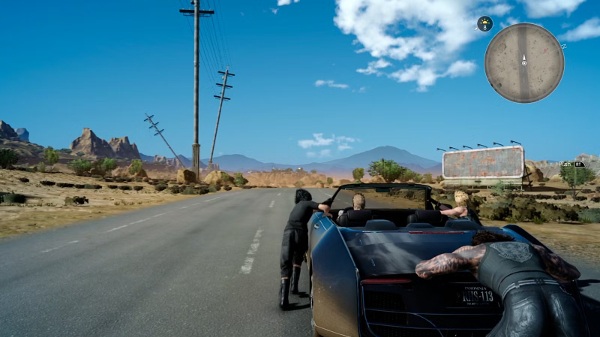
The save system in FFXV is generous, allowing you to use multiple slots rather than locking you to one, and I sometimes kept a “safety” save before entering a dungeon just so that I could work out exactly how many items I’d be consuming along the way. And let’s not forget that no amount of item consumption can help you if you’re under-levelled and getting wiped; often it’s necessary to hurry out of a dungeon and cash in your experience before making a fresh attempt. It’s at this point that you return to the open world, looking for “repeatable” bounties that can be exploited for money and items to sell, and it’s also at this point that I remark on how “un-Final Fantasy” so much of this is. In any other game, I’d just get more money from the battles themselves, and managing a reduced HP cap would be a unique occurrence instead of becoming bafflingly routine. Here, I’m using sidequests as my source of income, building strategies around my consumables, and daring to see how far into a dungeon I can survive. And yet, I can feel the game begin to charm me with its weirdness.
Whilst I talked about this game having one of the least fantastical openings in the series, I have to give it credit for some awe-inspiring scenes where the mundane pursuits of humanity collide with elements of the fantastical. A cutscene in chapter 9 sees a character, Luna, hold negotiations with the sea creature Leviathan – and there’s something admirably charming about watching “tiny JRPG girl” trying to talk down a terrifying god-beast. It’s the kind of thing that I feel like Terra would have been doing to the frozen esper Tritoch (or Valigarmanda) in Final Fantasy VI if the developers weren’t restricted to static sprites and simple animations. Or there’s the party of heroes – Noctis, Prompto, Gladiolus and Ignis – impressively powerful individuals who will obliterate rooms full of enemies with their magic and summons… but who spend their nights by a campfire, conscious about the amount of fuel needed to get the Regalia to its next destination. Rather than making them feel weird and out-of-place, the fantasy elements occasionally end up feeling quite striking because they occur amongst more “ordinary” interactions. When you’re given a chance to breathe, Prompto will offer a chance to show you photos that he’s taken during the current chapter, and (like Earthbound’s photographer) reframes the adventure as something where memories are captured and cherished, as opposed to being something that’s merely a “container” for set-pieces designed to satisfy the player.
Adapt or die
As much as I warmed to the weirdness, my general appraisal of the experience did include some lowlights. A late-game encounter against the enemies “Rogue” and “Mystic” was more frustrating than fun, the long journeys for items (and fuel) can feel like artificial padding at times, daemons were a chore to fight and some encounters that relied on gimmicks simply weren’t that great. It definitely feels like the first attempt at a style of gameplay that became much more refined during Clive’s adventures in FFXVI (or indeed the ongoing journey of Avalanche in the FFVII remake trilogy.) I picked up the “Windows Edition” of the game for PC at a discounted price (around £10 during a Humble sale) – and maybe that’s why I can be critical but still respect the overall experience. It was a fun, but flawed, way to spend 27 hours (actually 26:50, finishing at Lv42) – and knowing what I know now, I’d probably have a better time with the game if I opted to play it again. With that many caveats, it has made it pretty difficult to recommend to others when I’ve been talking about it – but you have to work with the weirdness and adapt to it, finding a way to make it work to your advantage. Even then, the experience may be more limited than what you’d prefer.
Once the FFVII remake trilogy concludes next year, I imagine that conversation may return to the main series and whatever a seventeenth entry could bring to the franchise. Clive and Noctis have made it clear that a third-person action template is favoured (internally if not necessarily by fans), and although I secretly pine for a new mainline sequel that returns to a fully controllable party and traditional turn-based encounters, I still admire these experiments in the real-time action space – and, if nothing else, would welcome more campfire bonding and deity communion.
Final Fantasy XV is available on PS4, Xbox One and Windows platforms.
Leave a Reply