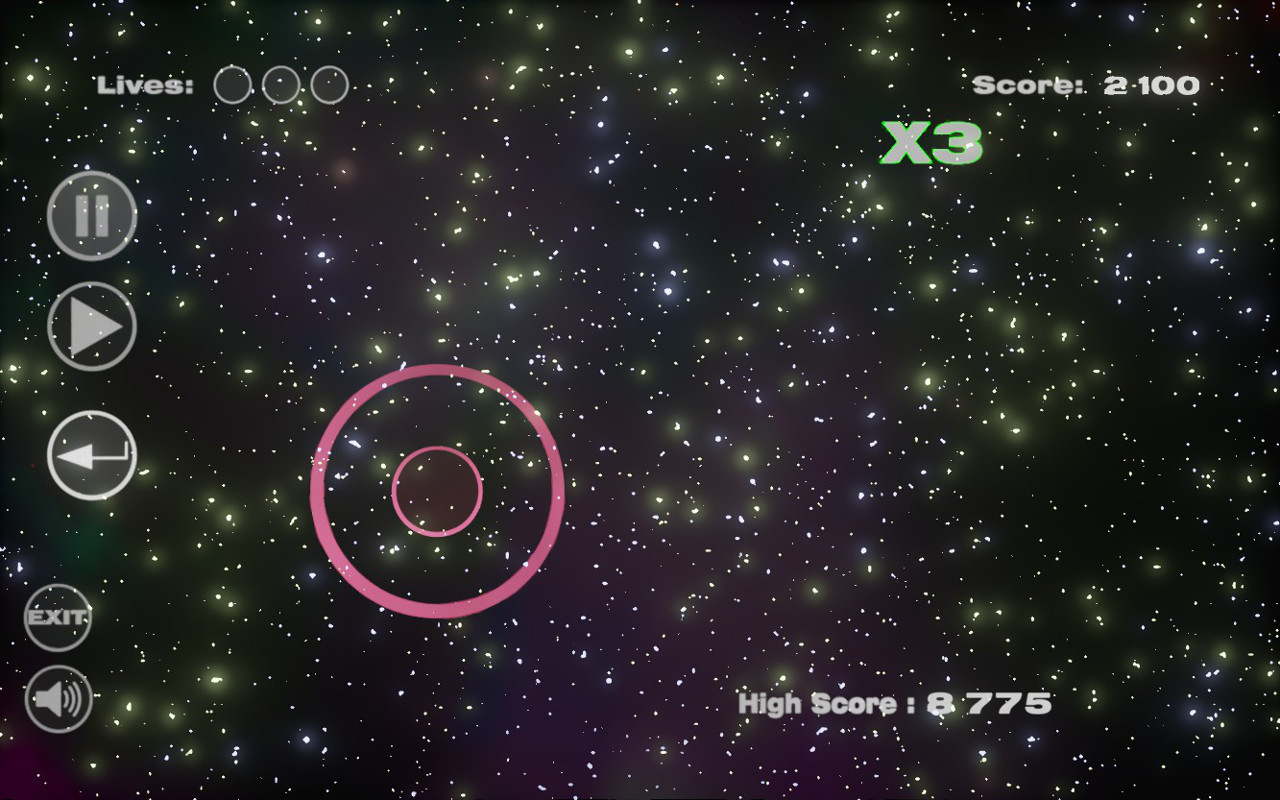
Released in late July of this year, Radial Impact is an arcade-style downloadable title that tests players’ reflexes by challenging them to click rapidly expanding or contracting circles as they come into contact with a second circle of a fixed size.
It’s a style of gameplay that sounds similar to rhythm-action games such as Elite Beat Agents or Technic Beat, but Radial Impact feels like a fairly hollow experience compared to those games. For one thing, Radial Impact isn’t really a rhythm-action game. Yes, there is background music and the timing of your clicks determines how successful you are, but when the circles grow or shrink to meet with the fixed circles, they do so with no regard to the game’s soundtrack. Far be it for anyone to criticise a game for what it’s not, but when you see that there’s no relationship between the gameplay and the music, what you’re left with is a reaction test. Consequently, the whole MO of the game is ‘click the circles when they meet for a high score’ and you end up feeling like you’re taking part in some kind of neurological exam.
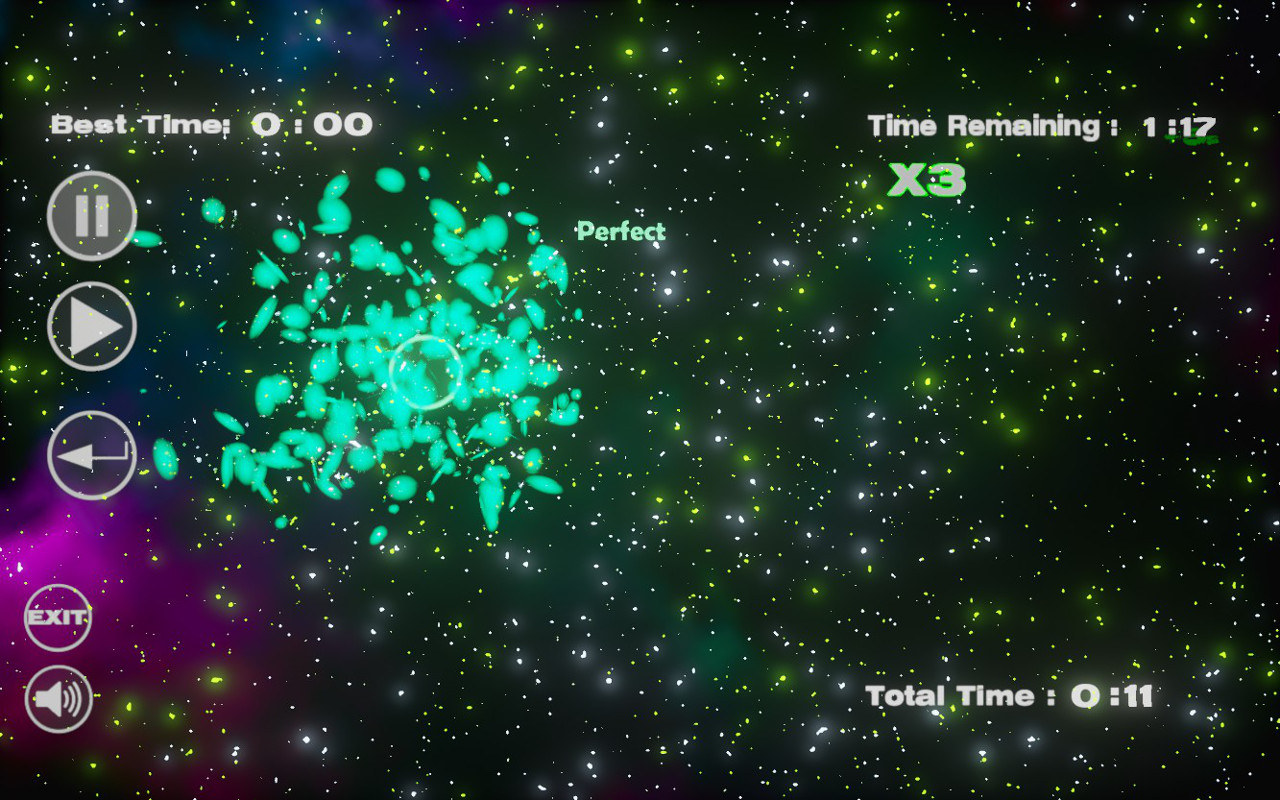
Depending on how good your timing is when you click, you are rated “Perfect”, “Excellent”, “Good”, “OK”, “Bad” and – if you mistime your clicks entirely – “Miss”. Consecutive perfect clicks will increase a score multiplier, whilst anything less than perfect resets the multiplier to x1. Meanwhile, a bad click or a missed click costs you one life and when three lives are lost, the game is over. There is also a special time-slowing ability that you receive after five perfect clicks in a row, but the varying speeds at which circles expand or contract mean that there’s never a good or bad time to use the ability.
Outside of the main game, There are a couple of other gameplay variants available. “Time Trials” mode sees you playing against the clock and earning extra seconds with well-timed clicks. In the other available mode, “Waves”, you are given a fixed number of circles to click and a score target to reach before you run out of circles to click.
Whilst the opportunity to play different game modes suggests that there’s some variety in Radial Impact, you’re actually doing exactly the same thing in all three modes – the ‘win’ condition is the only thing that’s changed. If there were game modes where the circles faded to become invisible before they met, or pairs of circles moved around the screen as they grew or shrunk together, or circles had randomised lengths and widths that made them look like skewed ovals… well, any of these hypothetical changes would make the moment-to-moment gameplay feel slightly more varied and interesting. Instead, the three available modes are more or less interchangeable. You could recreate the Time Trials and Waves modes are both variants without the game offering you to them, provide you have a stopwatch to hand and can count in your head.
Maybe I’m expecting a little too much from what is essentially a 79p downloadable indie game, but low prices don’t make shallow games any more enjoyable. Whilst there’s nothing inherently flawed or frustrating about Radial Impact, it doesn’t have enough variety or substance to hold the attention of the player for too long. You can see most of what the game has to offer in a matter of minutes, and after that you’re only going to go back for higher scores. I struggled to see much variety in the visual presentation or the soundtrack as I played and so there isn’t even any kind of sensory reward for keeping a high-scoring combo going. It’s nice that Steam has enabled these kinds of abstract arcade-style games to sit alongside conventional shooters and strategy games but this style of game could be done so much better. Ultimately, Radial Impact feels like a missed opportunity.
Priced at £0.79, €0.99 and $0.99, Radial Impact is available now on Steam.