Disposable Media

Art, Music, Games, Life

  • Art And Literature
    • Comics
  • Music
  • TV & Film
  • Games
    • Tabletop Games
  • Technology
  • Life
  • Events
  • Magazine Downloads
You are here: Home / Archives for steam

FFV late impressions: the job centre

2nd May 2022 By Qazimod Leave a Comment

The further back we go, the less I know. I was one of those casual types who barely knew what Final Fantasy was before VII, and ever since then I’ve jumped around the series to see if there was anything else that I missed when I was interested in other games. At least when I think of publishing FFV late impressions, I realise that I kind of had an excuse at the time. It was first released on the SNES (sorry, Super Famicom) in 1992 in Japan, and Europe didn’t get to see it until the 00s and (in the case of PSN and mobile) the 10s. I got around to playing the Game Boy Advance release earlier this year – honestly, it’s not a game that I knew a lot about and so it’s not like I was choosing to play it based on its reputation (unlike my FFVI and Chrono Trigger playthroughs), but I had heard a few good things about it. The game centres around our heroes vowing to restore order after the villain Exdeath shatters the elemental crystals in a bid for power. It’s your typical JRPG format of going from new town to new dungeon, obtaining more abilities and encountering new opponents, culminating in a showdown with the antagonist. Dungeons have some light puzzling and locked-door scenarios, as well as hidden routes to rare treasures – generally, it’s a comfortable RPG template that you can quickly enjoy without being bombarded with too many strange gameplay systems.

FFV late impressions – jobs and abilities

That said, one thing I took away in my FFV late impressions was that the implementation of the job system was more flexible than I expected. I don’t always like job systems in RPGs, because they put a lot of pressure on me to create a sensible range of skills and abilities across my party. I’m not that guy who sets up a team of four white mages, admittedly, but I do feel a certain amount of artificial pressure to “get things right” and not screw myself over in the late game. With FFV’s job system, each job allows a party member to equip certain gear and use special abilities in the battle menu – a thief can steal items from enemies, black and white mages use spells that cause elemental damage or support the party, and so on. However, each party member has a “job” slot and an “ability” slot; after using a job for long enough, the skills associated with that job are unlocked as abilities. This means that you can assign a skill as an ability and then start learning something else in the job slot – creating a summoner who has the thief’s stealing command, or a monk with magic capabilities.

It may seem like a small thing, but it blows open your tactical options – your four party members have their two slots to play with, and at the end of my playthrough I had 21 jobs available as well as the Freelancer (who has two “ability” slots and can wield any gear.) It’s a very different vibe from FFVI (where nearly every character had one “job” throughout the game) and FFVII (where “jobs” are essentially materia and anything goes), but FFV’s own freedoms and restrictions make it satisfying to try different combinations of skills to see what works. By the end of the game (for those curious about the commitment: 38hrs on the clock, with all party members around Lv50), my party was using four different types of magic (blue, black, white, time), controlling enemies (beastmaster), defending against attacks (knight), using summons (summoner) and dealing huge physical damage (with the monk’s “barehanded” ability.) It’s like working with eight party members, but it adds a tactical edge because you still only have four “actions” in your turn.

The grind

The jobs don’t save the game from the usual RPG hurdles, however. I can’t summarise my FFV late impressions without saying that there is still grinding, there are still plenty of random battles, and there are some miserable encounters if you’re not suitably prepared. Towards the end of the game I was being battered by more status ailments than I could deal with in my turns, and so I had to train up someone with time magic to help myself. Also, the random battles can be a nuisance when you’re also finding your way around a dungeon (although gear such as the Chicken Knife – which makes the party auto-flee an encounter and will discharge powerful attacks after fleeing enough battles – make navigation a bit smoother.) As much as I like this game’s jobs and abilities, the later games excel in the moment-to-moment business of dungeon exploration.

FFV late impressions – where to go
FFV late impressions

In late 2021 Square Enix released the “Pixel Remaster” of Final Fantasy V – I don’t know if it’s a particularly good remaster, but there should at least be options if you’re keen to play this but only have modern hardware. I played the GBA game and it was generally fine, but I have no knowledge of the other versions to compare it against. I don’t know if I’ll look even further back through the series history another time, but I’ve enjoyed this entry. If you have any fond memories of Final Fantasy V, don’t forget to leave a comment below.
Filed Under: Games Tagged With: ffv, final fantasy, Game Boy Advance, games, GBA, mobile, playstation, PS1, psx, snes, Square, square enix, steam, super nintendo

Chrono Trigger Revisited – a 2021 retro project

8th May 2021 By Qazimod Leave a Comment

Chrono Trigger Revisited? Well, my first visit was cut short in the end. Like Final Fantasy VI (or Final Fantasy III, if you will) this was a game that had been on my list for a while. I was one of the heretics who barely acknowledged JRPGs in the 16-bit era, and we grew up with a Sega Mega Drive rather than a SNES, so I was even more in the dark when it came to FFVI and CT. I’ve been aware of their impact ever since the 1990s, and I think at one point I even had a friend install both games onto a modded Xbox… but I was too distracted by Super Mario World and R-Type III to give Square’s RPGs any attention. Over the years I made a few half-hearted attempts to play through Chrono Trigger, but I often find the time investment for JRPGs somewhat intimidating. Even so, FFVI and CT are two games I’ve always wanted to play through, and I think that finishing FFVI last year motivated me into retrying the other game.

Chrono Trigger Revisited – a series in a single game

Chrono Trigger Revisited

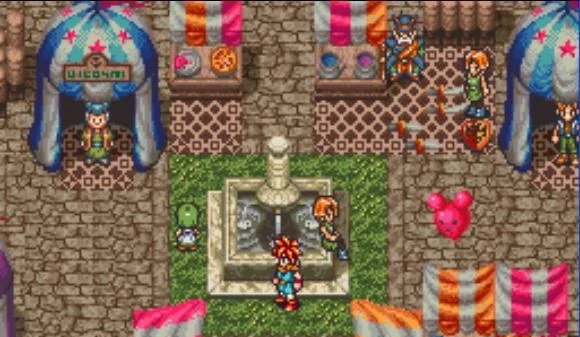
Chrono Trigger settles you in for a classic example of science going too far – as Lucca demonstrates a teleportation device at the Millennial Fair, the pendant of willing volunteer Marle interferes with the device and sends her through a time portal. This sets up the ensuing journey – going through the portal ourselves so that we can find Marle and get back to the present day safely. However, what makes CT so uniquely enjoyable is that this is just the first “quest” for our heroes. Before embarking on Chrono Trigger Revisited, I’m not even sure how much progress I made during my previous attempts… but I found that this wasn’t a simple “rescue the damsel” premise designed to set up the rest of the game. Instead, it was just one of the many adventures our party would have before the credits rolled. Like I said, the time investment needed for old JRPGs can be really off-putting for me, but CT’s structure and format is built in such a way that it feels less like an epic quest and more like around 20-25 “chapters” of an animated adventure series. What this means is that I ended up spending just under 32 hours playing through the game, and throughout that duration it rarely felt like a chore – the story was regularly going to different places, and whenever I spent an evening with the game I felt like I was ending one smaller adventure and beginning another. (Even at the end of the game, you have a series of optional sidequests to perform, but the game is very polite at arranging a to-do list for you; just speak to the old man at the End of Time.)

Chapters and spikes

Admittedly, this is nothing new – most classic JRPGs drop you into one location and establish a miniature quest as part of the main arc – but it lends itself so well to Chrono Trigger. It even extends to a system level as well. Not only are you travelling through time to resolve a problem and then moving on, but each miniature adventure is given its own name in the save files. Each time you save your data the text for the save file displays a chapter name; this is never shown during gameplay, but it has the effect of making your adventures feel self-contained. It’s a simple but effective way of reinforcing a sense of progress. Now, it’s still fair to say that you’ll be spending a lot of time in each of these chapters – there are minigames to complete, and plenty of battles and levelling to be done – but even then, your progress isn’t delayed for long. Over the course of the game your characters learn “techniques” that are your MP-governed skills used in battle, and these can be learned naturally through play or brute forced by grinding in areas – it’s up to you. As you’d expect, MP is only limited by the number of Ethers you can carry, and you’re continually making money as you battle. The game always finds a way to accommodate your time.

These chapters are also prolonged by certain bosses that can feel a bit like difficulty spikes at first, but I don’t think I really spent more than one play session where I was struggling against the same boss. At one point during the “Fated Hour” chapter I was so alarmed by my defeat at the hands of a boss (during the “Black Omen” sequence) that I levelled up my main party around ten times (the area leading up to the boss had lots of battles that rewarded generous levels of experience.) Admittedly, this may have been overkill, because I cruised through most of the rest of the game, but generally the difficulty spikes are few and far between, and you don’t need very many grinding sessions to overcome each obstacle. (Again, spending lots of money on support items – Mid Ethers, Revives – also helps.) At other times, it might feel like the dice rolls simply aren’t going in your favour; you’ll be trying to recover from a boss’ ultimate attack and they’re already charging it again… but perseverance, levelling and preparation helps. (Or if you just want to have more turns available, I found that having someone with the Haste skill was often beneficial.)

Chrono Trigger Revisited – wrapping up

Chrono Trigger Revisited

There were a couple of other nitpicks I had during my Chrono Trigger Revisited project – some of the minigames felt a little fiddly (visiting an ice world and avoiding strong wind currents by standing behind rocks sounds fine in theory, but the game is very particular about where you stand), and some exploration sequences had fairly dull gimmicks (guiding Robo through a maze of conveyor belts and switches in order to carry an electric current before it is lost.) However, the rest of the game makes up for these moments. I ended the game with my main character levels at between 67 and 69, and with between 31 and 32 hours on the clock, so it took me fewer hours to complete than FFVI. I’d rather not rate one game over the other, but I feel like CT has a much better structure, whilst FFVI has more potential for silly balance-breaking in a traditional structure. FFVI doesn’t let you tie a bow on a chapter, but it does let you annihilate enemies with Cyan’s Bushido and Sabin’s Blitz techniques, or cast Ultima on foes for 1MP with a relic you found on the world map. That being said, I think that more RPGs can benefit from looking at CT’s tidy, manageable structure. Oh, and both games have pretty great soundtracks – my main standouts in FFVI were the Gestahl Empire theme and the “Awakening” theme… in Chrono Trigger, the Undersea Palace theme stood out as a bold and atmospheric piece that immediately sets the tone in the areas where it’s used.

That’s pretty much all I have to say until my next mammoth retro game undertaking, although this and FFVI were the “big” ones on my personal bucket list. Thanks for indulging me, and let me know in the comments if you have any particularly fond Chrono Trigger memories.

Chrono Trigger was originally released on the Super Nintendo, and re-released through various updates on PSOne, Nintendo DS and Steam.

Filed Under: Games Tagged With: chrono trigger, games, nintendo ds, psone, Square, square enix, steam, super nintendo

FFVI late impressions: notes from a newbie

4th October 2020 By Qazimod 1 Comment

This article has been some time in the making. In the 16-bit era, I grew up with the Sega Mega Drive and missed out on a lot of SNES classics. Of course, that didn’t stop me from trying to emulate Final Fantasy VI and attempt to play it on PC, but a busy gaming schedule and a short attention span meant that I never gave it the time it deserved. I did “buy the game” years later via the SNES Classic Mini, but even after making a spirited effort to play it on that machine, I only ended up saving myself into a corner – stranded on the floating continent with an underlevelled party who wouldn’t be able to make it back to the world map. (In hindsight, I may have had a Warp command or item available and didn’t realise, but I’d have to check the save…) Honestly, I didn’t intend to write an FFVI late impressions article in early October because I didn’t know I’d be playing the game; however, I’ve had a pretty quiet gaming schedule and so it’s been a fun way to pass the time.

FFVI late impressions – the old

FFVI late impressions

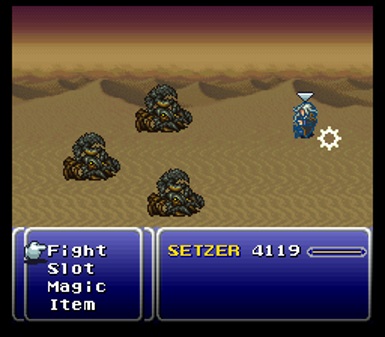
Final Fantasy VI has some novel and inventive moments, but its foundations are quite old-fashioned. You travel the overworld between towns and dungeons engaging in random battles until you’ve levelled up enough to take out the next thing that’s in your path. Random battles are frequent, and blasting through so much fodder might seem chorelike if I wasn’t already familiar with old-fashioned RPGs. To its credit, the character variety allows battles to remain interesting – each new party member that joins the cause has a unique skill that opens up more tactical options when they’re battling with your party. Early on in the game you might find that a few allies are struggling, but you’ll press on because you’re confident in nailing Sabin’s Blitz techniques, and so he can do a lot of the heavy lifting. Later on you’ll see Setzer’s slot-machine ability (which Cait Sith would later pinch in FFVII) and train yourself in reading the reels and making the most of their benefits. Elsewhere, Cyan has multiple special attacks available if you’re willing to wait before taking action – it’s not the most exciting tactic… but since enemies are still active as you wait, there’s an element of risk. However, not all of the techniques are that amazing – I got a few abilities for Gau on the Veldt but the ones I obtained stopped feeling useful in the later areas. Meanwhile, I think I got all of Mog’s “Dance” techniques, but he was in my tertiary party at the end and so he never got a look in – apologies to Mog fans reading this.

Setbacks

FFVI late impressions

The battles themselves aren’t too bad, but the setbacks can be offputting. After revisiting content that I knew from earlier playthrough attempts, I was playing pretty blind – and so I wasn’t always sure when I’d be underlevelled or overlevelled. I actually ended up using the three available save slots so that I wouldn’t have to go back too far if I was underlevelled. (Although once again, I could have used things like the Warp technique – or the equivalent item – a little more during my playthrough; it essentially whisks the party out of a dungeon safely, and I only really started using it in the final tower area.) One element of modern RPGs that I did miss was the concept of “passive” levelling; where the characters who aren’t in your active party still gain a fair amount of experience. I’ve heard that certain events allow party levels to become “averaged” so that nobody falls behind too much, but I still ended up with a few alarmingly under-levelled characters late in the game, and this became a bit of a problem during certain sequences in the final dungeon that involve your entire party. That said, this is still something that I’m guilty of in modern RPGs – many playthroughs of Persona 4 leave the likes of Kanji and Yosuke laughably underpowered. So whilst I enjoy passive levelling, I’m willing to accept that I could have made better decisions.

FFVI late impressions – perks

FFVI late impressions

Outside of the unique skills, some other fun events can come together that make things more manageable. One particular game changer in this playthrough came from the Economizer relic – I found this as a rare drop from a battle in a north-eastern region of the world map (I think online resources give it the nickname “Dinosaur Forest” or “Dinosaur Island”), and it reduced magic cost to 1MP for one ally. No big deal in the early game… but when used in conjunction with more expensive skills such as Ultima, it made certain encounters a pushover. (Another relic, the Gem Box, allows an ally to perform their action twice during the turn, so they’d spend 2MP and unload Ultima twice. As you can imagine, it got kind of silly.) When modern games are so determined to gate so much of the fun behind busywork and marketplaces, it’s refreshing to find overpowered nonsense that’s fun to use in a game such as this. And of course, this wouldn’t be a series of FFVI late impressions if I didn’t mention the Espers – powerhouses that can be summoned to provide invaluable abilities that help your party in battle… if you’re willing to spend the MP. To be honest, I spent a lot of the endgame using character-specific special techniques and basic magic attacks because Esper abilities always seemed pretty expensive, but I still took the time to unlock skills for the ones I had (The discovery of Ragnarok led to my cheap Ultima double-casting – I also found a shield that granted the same skill to another ally, but it seemed a waste when the Economizer, Gem Box and Ragnarok were so much more efficient) Again, that unlocking could sometimes lead to a bit of a grind, but at least there were world map areas that would make progress a little quicker.

Consequence and character

During my first draft of this article I didn’t really think about mentioning the story or characters too much because it’s all so well-known, but I was impressed by how compelling it all remained. Yes, some of the character traits can feel slightly one-dimensional, and since the post-FFVII explosion of games and spin-offs it’s easy to think that the story might just feel like another Final Fantasy story, but I can appreciate how interesting it would have been at the time. Themes of darkness and chaos exist, but there are still moments of levity and humour that don’t feel too jarring – small-scale silliness such as the recurring encounters with Ultros, and more infamous moments such as the Opera House scene, which manages to be charming, engrossing and funny without feeling like a mess. Also, despite the attention placed on Terra, it doesn’t feel like it’s forcing any one character to be the hero in the way that FFVII pushes Cloud. There’s always the possibility that people will have their favourite party members as the game goes on – whether for story or gameplay reasons – but most of the allies recruited to the cause are likeable enough.

FFVI late impressions – high scores

So where did my party end up during the finale? Most of the characters had levels in the low to mid-50s, with two in the high 50s, two in the 60s and one level 82 character (the Ultima double-caster who was involved in most of the damage-dealing late in the game.) My last save before finishing the game showed a playtime of 42 hours and 49 minutes, which apparently isn’t too bad: the time for “All Styles” on the website HowLongToBeat suggests that a typical playthrough is around 41.5 hours long. (As an aside, I also tweeted my progress when I reached the World of Ruin – back then, most of my party was level 29 or 30, and I had 20.5 hours on the clock… so the two worlds split the game length fairly equally.) I did find the final stretch a bit of a drag even without the perils of under-levelled allies – there’s a lot to do for what often feels like the smallest amount of progress, and whilst random battles quickly become a formality, the party management and navigation of the environment (coupled with occasional long stretches between save points, or long treks back and forth when I wanted to warp to the world map) slowed things down for a while.

Despite all of this, I’ve enjoyed my time with the game, and wouldn’t be averse to revisiting it in the future. If the unique abilities and techniques were all equally interesting, and there was a generous form of “passive” levelling (in addition to the averaging) for other characters, I’d have no trouble recommending it, but even with the caveats it’s not too bad. Outside of my general gameplay impressions, I think that the main characters are all likeable… and there are some fantastic pieces of music throughout the game, from the epic “Decisive Battle” tune that plays during boss encounters, to the moody “Awakening” theme that offers a slower and more intimate variation of the world map music. Since I personally have more history with FFVII, the adventures of Cloud and co. may still mean more to me, but I can definitely see why this is held in such high regard.

Final Fantasy VI was originally released for the Super Nintendo in 1994 – however, ports exist on PS1, GBA, Steam and mobile. You can also find the game on the SNES Classic Mini.

Filed Under: Games Tagged With: FFVI, final fantasy, Game Boy Advance, games, GBA, mobile, playstation, PS1, psx, snes, Square, square enix, steam, super nintendo

Notes from Inaba

28th June 2020 By Qazimod Leave a Comment

Recently, I finished the Steam version of Persona 4 Golden. We covered the news of the release earlier in June, and since then I’ve been experiencing P4 again on a whole new platform, and recollecting my notes from Inaba. It may seem a bit too far for a fan to move from a home console game to a portable release… and then back to a port that will be played at a desk (laptops are an option, but I’ll probably be playing the game at home.) However – as a place to play electronic entertainment, the PC is pretty much immortal. Whilst I could have found a way to play P4 on a big screen without buying another release, I would have had to find my old PS2 and hoped that it still worked, not to mention the fact that I’d be tolerating the original release which lacks the enhancements of Golden. Meanwhile, the Vita version isn’t going to go anywhere, but if you were late to the party then you still need to track down a discontinued piece of hardware rather than relying on your trusty desktop or laptop. The devil’s advocate in me would say that PC gaming still requires you to track down and keep the right specification, operating system, and – in many cases today – a launcher such as Steam. However, I’d like to think that those things would last for a while once you’ve obtained them.

Notes from Inaba – conversion quality

Notes from Inaba

My notes from Inaba are generally pretty positive – the core gameplay is more or less untouched, but the quality of the port is as good as I could ask for. The visuals look great on a new monitor at high resolution (although things like facial detail on character models are always going to be unvoidably goofy), the game provided a smooth experience from start to finish – the brief pauses that I mentioned in my previous article faded into insignificance pretty quickly; they never impacted active gameplay, after all – and when you plug in a PS4 controller and use a half-decent LCD display, you can retreat to your sofa and forget about any perceived awkwardness of PC gaming. (Well, most of the time – I had one or two moments where everything froze and I had to force an exit, but I can’t say for sure whether that was due to the game or a result of my own background processes that may have been interfering. Also, keep in mind that those one or two moments would be in a 40-50hr experience, so it’s a very rare occurrence.)

Bells and whistles

As far as I could tell, the core gameplay was untouched – there was no rebalancing of enemy properties, or brand new encounters – everything I saw indicated that the people responsible for this release wanted to leave as much of it intact as possible, and just polish certain areas to suit the PC experience… whether that’s via higher resolutions, extra customisation options, or anything else that a Steam user might expect. There’s not a whole lot that I can say about the gameplay that I haven’t said in the past; it has some of the best pacing of any game in the series, the elemental affinity system and social links are as satisfying as ever, the focus on smaller unique dungeons (rather than intermissions from a Tartarus or Mementos) helps to keep things varied, and the characters are charming and likeable. It also has a soundtrack that’s as least as good as Royal‘s, and whilst the investigation sequences in Inaba still feel kind of meaningless, they’re over quickly. Furthermore, it has slightly more relatable narrative compared to other games in the series, with large amounts of dialogue and story revolving around the themes of identity and sense of self. Critics have poked holes in the messaging contained in these moments, but the supposed counterpoint is that games can have characters with flawed ideals. To say more would lead us into spoiler territory, so our notes from Inaba can probably be wrapped up now.

Concluding notes from Inaba

Notes from Inaba

If you’re someone who only held on to their Vita because it was the only place to play Persona 4 Golden, you now have a worthwhile alternative. If the portability is what matters to you, you can keep your Vita or opt for a laptop. If you’re going to invest in the means to play the game – either by improving your current PC, buying a new one or picking up a Vita – let us know what you think of the experience. And no matter what happens, you can be sure of one thing: every day’s great at your Junes.

Filed Under: Games Tagged With: Atlus, Persona, Persona 4, Persona 4 Golden, steam

Persona 4 Golden is available on Steam today

13th June 2020 By Qazimod Leave a Comment

Earlier this evening we found out that one of Atlus’ most beloved JRPGs will finally find its way to an even wider audience – right now, Persona 4 Golden is available on Steam. Whilst I’ve talked a lot about the Persona series since the relaunch of Disposable Media, I never really covered Golden whilst the site was active, but it remains one of the most balanced games in the series, with plenty of content, a nice snappy pace, an engaging narrative and compelling gameplay. Whilst 1 & 2 were a bit slower due to their more involved gameplay, 3 suffered from the slightly samey nature of Tartarus, and 5 added in numerous ideas but sometimes suffered from ill-advised gameplay gimmicks, Golden finds a much better balance when compared to the older and newer games – it’s more streamlined than 5, but more varied than 3, and discards the complexities of the oldest games.

Persona 4 Golden is available on Steam – the beginning

Persona 4 Golden is available on Steam

Until recently, it seemed destined to remain on the PlayStation Vita, but I saw the rumours begin circulating sometime during Tuesday of this week. Naturally, I was sceptical – anyone following Persona 5’s release will know that the series is a magnet for ill-informed gossip and rumours, and I deliberately avoided publishing anything about this until today. The news that Persona 4 Golden is available on Steam was also shared during this evening’s “PC Gaming Show” – unfortunately, the news broke mere minutes earlier than the stream and people on Twitter were already sharing the Steam store page link – however, rumours had been pointing to the show being a perfect home for the announcement.

Every day’s great

Persona 4 Golden is available on Steam, and you can head to the Store page to check it out (see the link we’ve included below).  The description on the store page is somewhat brief: “With an overall Metacritic score of 93 and a multitude of awards, fan-adored Persona 4 Golden stands as one of the finest RPGs ever made, delivering on enthralling storytelling and quintessential Persona gameplay.Persona 4 Golden on Steam is best experienced with a game controller.” Below this, there’s mention of achievements, trading cards, “Full HD” visuals, “variable” framerates and voiceovers in Japanese or English. The mention of “Full HD” suggests that this will be displayed at 1080P rather than some 2160p upscale, but Persona 4 Golden’s clean style and bright environments aren’t begging for a massive graphical overhaul. The main selling point for me will be the fact that Persona 4 Golden has found a home on the PC, a gaming platform that’s as old as gaming itself. I often made light-hearted comments about the fact that I couldn’t part with a PlayStation Vita if it was the only way to play Persona 4 Golden… today, it seems like this could be the best place to experience the game. That is, if the PC version is any good.

Persona 4 Golden is available on Steam – the future

Of course, we’ll look forward to picking apart this Steam release in the future. You’ll have to bear with Disposable Media for a little while: as a site run by enthusiasts, we pick up games no sooner than any other enthusiast, and trying to deconstruct a new port of a 50 hour JRPG – not to mention one so highly-rated by fans – isn’t something that we can do carelessly. Depending on how the game plays I may end up following the example of Persona 5 Royal and writing separate pieces for early and late impressions, but I’m not sure yet. As always, let us know how you feel about this news, and if you’ll be picking the game up on Steam yourself.

Persona 4 Golden is available on Steam now for £15.99: the Store page can be found here.

Filed Under: Games Tagged With: Atlus, games, Persona, Persona 4, Persona 4 Golden, steam

Celeste’s DLC chapter is arriving next week

7th September 2019 By Qazimod 1 Comment

When I wrapped up 2018 with my obligatory round-up article I mentioned that Celeste quickly went from a game I wasn’t really too interested in to one of my favourite games from last year. It adopted the kind of punishing insta-death platforming format I’m usually too inept to enjoy and fine-tuned the pacing so that you were never so far from progress that you gave up on the game. Having great presentation and a charming story was also welcome, of course, but that tight gameplay made it hard to put down. The game already has a decent amount of content as it is; if you’re just interested in seeing the main story you can enjoy the first seven chapters, and then afterwards you can go for the crystal hearts, or even consider the B-sides and C-sides. Even beyond that, there are strawberries to collect and the lure of completing levels faster and with fewer deaths. However, fans are going to have even more content to enjoy when Celeste’s DLC chapter arrives next week.

Celeste’s DLC chapter: the details

Celeste's DLC chapter

What we know so far is the following: Celeste’s DLC chapter will be released on September 9th for all platforms (although Matt Thorston mentions that the Xbox One version may release a little later.) Players will get to enjoy a new 9th chapter named “Farewell”, but they must have completed the first eight chapters before they’re able to try it – that is, the initial seven chapters of the main story and the eighth chapter you can open up after fulfilling the necessary conditions. The new chapter won’t have a B-side or a C-side, but there will be “new mechanics and items to discover”. Thorston also mentioned on Twitter that the new chapter was originally going to be gated behind the C-side levels, but now this is no longer the case. It’s an interesting detail that might hint at the difficulty level one can expect from the chapter (although presumably players will still be able to use the Assist Mode if they’re struggling for too long.)

Hopes and expectations

Celeste's DLC chapter

As for me… I’ll admit that I didn’t go back for all of the optional bits and pieces, but I did unlock and complete chapter eight, so hopefully I can dig up an old save file that I have in the cloud or something. I’ve tried to resist snippets of footage and screenshots tweeted by the official accounts but I’m personally hoping for a similarly well-paced level structure, with checkpointing that feels generous enough to keep you hooked, but not so generous that all challenge is removed from the experience. Also I’m kind of hoping that we’ll get some narrative and dialogue to accompany the experience, since the writing in the original game was engaging and sometimes quite humorous. Finally, I’m curious to see how much knowledge of hidden tech will be necessary – will players need to be familiar with speedrun tricks to make impossible manoeuvres, or will the average human be able to make progress?

Celeste’s DLC chapter: coming soon

Celeste's DLC chapter

Summer is quickly becoming a distant memory, and my gaming schedule had been pretty quiet for the past few weeks, so this will at least be something to keep me occupied between now and whatever the next most interesting release is. We’ll hopefully have more coverage of Celeste’s DLC chapter on this site in the future, although that kind of depends on my own competence with the game. Let’s just say that if there’s a suspicious lack of Celeste news on Disposable Media I’ve either thrown up my hands in surrender or I’m still making futile attempts at progress. Let us know your thoughts on the new chapter in the comments below.

Filed Under: Games Tagged With: celeste, games, PS4, steam

Survived By: early access impressions

10th December 2018 By Qazimod Leave a Comment

Survived By is a game I stumbled upon after clicking my way through the discovery queues and “More Like This” lists you can find within the storefront of Steam. Described as a “free-to-play online bullet-hell style roguelite” on the Steam store’s product page, it seemed to cover a number of game genres I enjoy – okay, the “free-to-play” label sounded a few alarm bells… but the idea of running around with other players, shooting various foes and exploring a large map sounded interesting. I never really checked out Survived By in its alpha form, but after reading about the game’s premise, I added it to my Steam wish list so that I could be notified when the game was available, and on the 5th of December I received an email that told me Survived By could be played in early access form, so I had a little look at it last week.

Survived By: early gameplay

Survived By

Controlling the game with mouse and keys, you spawn into a central area with other players, and then you can set out to explore the world and fill out the map. In combat, you move with WSAD and aim and shoot with the mouse, and you can collect items and materials by walking over them. In the central area there are daily challenges that ask you to do x amount of damage or kill y number of enemies, and there are also “quests” that periodically occur whilst you are playing – usually these quests involve following a waypoint to a particular enemy and then defeating it. After playing for long enough and obtaining keys you eventually manage to unlock one of the dungeons (which has a suitably impressive name like “Monastery of the Rift”) – here, you enter a closed area such as a cave, move through winding paths that may lead to dead ends, collectibles or more enemies, and eventually you’ll reach and defeat a boss creature and gain items and gold as your reward before you head back to the public central area.

Survived By: exploration and pacing

Survived By

From my time playing, that central area was one of the more impressive aspects of Survived By – the shadowy incomplete map segments invite you to go further outside of the safer areas and find stronger enemies that may drop better rewards or give more experience, and my attempts to complete the map often lead to an early demise. Being a roguelite, death can see a player losing their character and having to create a new one that starts with no experience, so there’s always a certain amount of tension when venturing outward. That “bullet-hell” label might not result in Cave levels of insanity, but areas can get pretty busy with enemies and projectiles. The main concern I have at the moment is how the genre-blending could affect the pacing. In a multiplayer online game built around levelling and customisation, you want to find bigger and stronger challenges, but in a roguelite you don’t want to bite off more than you can chew. Survived By is both, and some players might find death somewhat punishing after they’ve gained a good number of levels. Although, that’s kind of the idea. I don’t know if it’s the kind of game that I could play for days on end, but it’s got enough going on to keep me curious, and I might drop back in on occasion to see how the game is developing. Right now, anyone can go onto the Steam store and take a look for themselves, but you will need to spend a few minutes registering and setting up a (free) account.

Survived By

You can play Survived By on Steam in its Early Access form here. You can read about more Steam news and opinions here

Filed Under: Games Tagged With: games, indie, pc, shoot 'em up, shooter, steam, survived by

Twin-stick indie title Shudder available today

31st August 2018 By Qazimod Leave a Comment

Innovation is hard. Merely coming up with a gameplay hook that makes your game stand out among the crowd is one thing, but even when you’ve discovered a winning formula, you still need to communicate to your audience and show them why your game is something special. Shudder is a masterclass in how to do this effectively – letting the player discover the game’s unique aspects through play, allowing them to understand what their avatar can do and how that affects the enemies on the field. There is a tutorial available, but the concepts explained in the tutorial really need to be witnessed through play. Essentially, you’re tasked with defending yourself against multi-coloured enemies named para-bugs whilst consuming collectibles dotted around the environment. (Even without the tutorial, the fact that the collectibles aren’t chasing you is a visual tutorial in itself.) As you pick up these collectibles a coloured hexagon grows at the top of the screen – fill this out and you can hit a button to “shudder” and stun all enemies of that colour, preventing them from moving and allowing you to move into them and “consume” them. However, there are several ranks of coloured hexagons and associated enemies, and every time you use your shudder you have to build up your coloured hexagons from the lowest rank again.

Voids and cubes in Shudder

Shudder

This is just the start, though. Continue to consume enemies and eventually an onscreen text will herald the appearance of a Vortex Cube – as enemies swarm around and collide into the cube, it will eventually begin changing colour. If the last coloured hexagon you filled out matches the colour of the cube, you can use your shudder ability to make the cube explode in a shower of bonus pickups, and bigger bonuses await those with more completed hexagons. Not only is this a great example of teaching the player through association – the cube’s own colour cycling invites the player to discover what happens if they shudder when their colour matches the cube – but it creates a unique tension; use the shudder early to eliminate foes, or continue progressing through the colours and destroy the cube later for a big bonus? Similarly, the Energy Void teaches players through experimental shudder usage as it draws in your collectibles and cycles through colours. Here, using your shudder ability when your last completed hexagon matches the Energy Void colour will cause an explosion that eliminates nearby enemies. The additional gameplay mechanics succeed in giving the player more to think about, and encourage priorities – is using the basic shudder ability more useful than taking advantage of the onscreen furniture? Should you capitalise on the Energy Void’s explosion or wait to gain pickups from a Vortex Cube? In addition, the game is also very thoughtful when maintaining an appropriate pace for experienced players – climbing the initial ranks seems slow at first, but as your run continues it seems quicker to progress through the early colours upon respawning.

The twin-stick success of Shudder

Shudder

What this results in is a satisfying loop of alternately feeling helpless and fleeing the incoming waves of foes…only to eventually decimate anyone unwise enough to still be chasing you. Of course, as the colour ranks increase you need to ensure that you can build yourself back up in time for another counter-attack, and so the loop continues – only getting more and more desperate as the crowds get bigger and the action intensifies. This escalation is judged expertly – you never feel like the waves are getting too strong too quickly, or that the hexagons are too slow to build up in time for the player to prepare a counter-offensive. Failure is always on you, and death leaves you wondering if you got too greedy or were too quick to use your shudder.

Beyond the core gameplay, a large range of unlockable ships is available to players who continue collecting the pickups from the exploded cubes, each with variations in their speed and multiplier behaviour and essential for those players keen to improve their high scores. Browsing the available ships and their costs, you can tell that this is where much of the longevity resides, but Shudder has a core gameplay loop that’s compelling enough to encourage continued replay even without the unlocks. During the rise of Xbox Live Arcade it seems like everyone was keen to put their own spin on the twin-stick genre, but Shudder proves that there’s still lots of room for innovation, and the £5.79 asking price gets you a game with more charm and replay value than most big-budget offerings.

Shudder

Shudder is available now on Steam here.

Filed Under: Games, Reviews Tagged With: games, indie, pc, saberphrog, shudder, steam

The new SF 30th lobbies are the best bit of the collection’s update

30th June 2018 By Qazimod Leave a Comment

It’s fair to say that the SF 30th lobbies turned out to be one of the biggest disappointments when I first tried Capcom’s most recent collection of fightjng games. You can talk about how the product is just a lazy collection of roms with a few token extras, how the museum could have had more content, how the display filters seem limited, and so on… but online play has the potential to inject new life into those old classics. That potential, however, was not shown in the initial release – attempting to set up SF 30th lobbies on launch day only resulted in a bizarre situation where the game would never register your opponent readying up at the lobby – and when your opponent had the same issue on their end, it led to some amusing exchanges. Happily, a patch was released this week that addressed the SF 30th lobbies (as well as fixing sound issues in the SFIII games, adding a connection-based matchmaking filter and banning Akuma from ranked Super Turbo games), and I was able to play a few games of Street Fighter II recently.

(Note: as I was joining a friend’s lobby I didn’t check to see if the previous issues with filtering by game were resolved, but the next day I tested some filtered searches myself and they still seem as bizarre as before, with search results ignoring the deselections you make – once again, if you only tick Super Turbo in the filter, you’ll see lobbies that only host Super Turbo, lobbies that host ST and Hyper Fighting, lobbies with all four games available, etc. So this is still a curious oversight.)

SF 30th lobbies – the stutter

SF 30th lobbies
Embarrassingly, the biggest issue I faced during my matches was probably a result of my own connection – I noticed a few momentary split-second pauses in a few matches as the netcode and my own connection tried their best to keep up with the action. These micro-pauses weren’t really an issue with a game as slow as Street Fighter II, but I think they may have had a worse impact if we were playing Street Fighter Alpha 3 or Street Fighter III: 3rd Strike. Like I said, I’m willing to take part of the blame here as I don’t know how much other network activity might have been going on at the time, but in casual friendly games where I don’t care about frame-perfect actions I think that these momentary stutters can be overlooked a little.

SF 30th lobbies – the spectators

SF 30th lobbies
When not in the middle of a match, waiting players can pass time in one of two ways. If they hit the Spectate button before the next match is underway, they can spectate the next match in the way we’ve become used to in SFIV, SFV and SFIII 3rd Strike Online Edition. If they don’t push the button, the lobby’s player list updates to show not only the active combatants, but also a crude graphical representation of their lifebars, a basic indication of round wins and the characters selected by the players. It’s a cute way to keep the spectating player engaged in the lobby activity even if they missed the button prompt, but it probably would have been better to assume players would want to spectate, and instead offer a button press if players want those basic lifebar and round win indicators. (As an aside, I didn’t look into voice chat that much, but I would assume it’s perfectly fine to use something like PSN’s Party feature – making sure that you have a headset that slots into your fighting game controller or a USB port, of course!)

SF 30th lobbies – getting there

SF 30th lobbies
Like a lot of aspects of the collection, online play doesn’t feel revelatory but at the same time you can still play it without wishing you were in the middle of another Fighter with seemingly solid netcode. Online play in this game is neither flawless nor a disaster, but it is “good enough” and perhaps makes up for the lack of substance elsewhere in the collection. I still have to give the other online-enabled games more lobby time, but if you’re keen on killing a few hours with online friends, SF 30th lobbies might tick that box for you.

Street Fighter 30th Anniversary Collection is available now for PS4, Switch, Xbox One and PC.

Filed Under: Games, Reviews Tagged With: capcom, microsoft, nintendo, pc, playstation, sony, steam, Street Fighter, Switch, xbox

Street Fighter 30th Anniversary Collection review

30th May 2018 By Qazimod Leave a Comment

Never underestimate the strength of “convenience” as a selling point. A new compilation of games from your favourite series has been released – that’s great! Oh, but what about when you move on to the new generation of hardware, or when more games from the series have been released? You’d better make sure that you pick up the next compilation as well. And so it goes on. I’m bringing this up because when I saw the amount of games listed as part of the Street Fighter 30th Anniversary Collection, I felt relieved that I didn’t have to dust off my Xbox 360 to play 3rd Strike or the SFII series – similarly, I thought it would be nice not to be left digging out the PS2 every time I wanted to play the SF Alpha games on the Anthology. And sure, there’s nothing on this collection that you couldn’t emulate on PC, but even that would involve BIOS hunting, controller configuration, hooking the PC up to the TV and more bits and pieces that feel… well, inconvenient. Let’s take a closer look at those listed games – the Street Fighter 30th Anniversary Collection has the original Street Fighter (itself something that I haven’t seen since maybe the Capcom Classics compilations on PSP), all major SFII games (with the exception of the Switch-exclusive Ultra SFII), all three SF Alpha games and all three SFIII games. It’s the most generous and convenient collection of Street Fighter games I’ve seen in a while, and you can play it on the same system you use for SFIV and SFV matches. Well, if you own a PS4 or PC.

Street Fighter 30th Anniversary Collection – curious lobbies

Street Fighter 30th

Unfortunately, some people may be disappointed if the best thing to say about the Street Fighter 30th Anniversary Collection is “well, all of the games are there”. Training modes are stuck in the past as you practice against a dummy – there are no trial modes or combo examples that help you learn. Online lobbies are a welcome feature, but searching is unusual – first, you toggle the games you wish to find lobbies for, and then it shows results based on those toggles. You’d think this would be useful if you’re never going to play Alpha 3, but instead the results ignore the games you’ve deselected. If you just want to play 3rd Strike, you’ll see results for purely 3S lobbies, but also lobbies for combinations of games that include 3S. I’m not too bothered because most of my online play will probably come from invites to private lobbies from friends, but it’s still peculiar.

There’s also a Museum segment with a series timeline and zoomable art, character details (including bio details and a neat sprite viewer), a “Making of SF” segment and – my favourite inclusion – a Music menu with playlists from all twelve games. There are even shuffle and repeat modes for when I want to listen to Jazzy NYC all day. The repeat function won’t go as far as making clean loops from the songs, but it’s a fun distraction.

Street Fighter 30th Anniversary Collection – memory lane

Street Fighter 30th

As for the games themselves? They mostly play how you remember – SF1 is still a nightmare to control, Alpha is all about daft custom combos and neglected ISMs, and 3rd Strike isn’t the labour of love that Iron Galaxy released last gen, but it’s still lots of fun. The online play seems smooth enough – I’ve had hardly any issues jumping around with my SFII Honda, getting guard crushed in Alpha or dashing through opponents with my Ibuki in 3S. After a win or loss there’s the option to rematch, but again, there aren’t the bells and whistles seen in 3rd Strike Online Edition such as visible ping or disconnect rates. Of greater concern is the weird nature of joining friends’ games – right now people are running into situations where both players will try to ready up for a match, but they can only toggle what looks like the ready status of the opponent, and even if both players try this it still looks like only one player is ready. Cue a lot of “why haven’t you hit the button” confusion until both players realise that the game can’t communicate the ready status correctly. Hopefully this gets fixed soon.

For the time being – especially in terms of local play, where a lot of my time will disappear – I’m satisfied with the Street Fighter 30th Anniversary Collection. Again – it’s hard to think of another Street Fighter collection that’s this generous in terms of games offered, and whilst more could have been done in terms of training/challenges, better lobby filters, more display options (there are screen size and filter toggles but they seem more like a token gesture) or even dipswitches (something I appreciated in 3S: Online Edition)… if you just want to play the games without swapping consoles or configuring emulators, it might be worth a look.

Street Fighter 30th

Street Fighter 30th Anniversary Collection is available now for PS4, Switch, Xbox One and PC. The official website can be found here.

Filed Under: Games, Reviews Tagged With: capcom, microsoft, nintendo, pc, playstation, sony, steam, Street Fighter, Switch, xbox

  • 1
  • 2
  • Next Page »

Get Social

  • Facebook
  • Instagram
  • LinkedIn
  • Medium
  • Pinterest
  • RSS
  • Twitter
  • YouTube

Top Posts & Pages

  • Nier Automata Piano Collections - impressions
  • Dan's Disposable 2020 - Highlights From The Year
  • Narcos Netflix Original Series Review
  • Save on Street Fighter T.N.C 04 Guile Figurine
  • Rogue One: A Star Wars Story Comes to VHS?
  • Backwards Dungeon Crawling – how not to play Metaphor

Ads

Join Us…

  • Facebook
  • Instagram
  • LinkedIn
  • Medium
  • Pinterest
  • RSS
  • Twitter
  • YouTube


Privacy Policy

Cookie Policy

© 2026 Hot Mod Media · Design & Marketing TWOTW

Disposable Media · FPSPrestige · OnlineRaceDriver · The Guitar List · Rescars · Rescogs

We use cookies to ensure that we give you the best experience on our website. If you continue to use this site we will assume that you are happy with it.