Disposable Media

Art, Music, Games, Life

  • Art And Literature
    • Comics
  • Music
  • TV & Film
  • Games
    • Tabletop Games
  • Technology
  • Life
  • Events
  • Magazine Downloads
You are here: Home / Archives for puzzle

Tetris Effect: first impressions

9th November 2018 By Qazimod 1 Comment

Tetris Effect is a game with a pitch that either sounded like the daftest idea ever or something that made perfect sense. Think about it: “Rez developer does Tetris”. On the one hand, this is an update of a game that dates back to the 80s and could be probably played on any modern portable electronic device, yet said update has been given an audiovisual upgrade so lavish – including support for the PSVR headset – that it verges on pretentious arty garbage. On the other hand, Enhance Games have made some of the most mesmerising gaming experiences in recent generations, and Tetris itself is a game that can be quite entrancing when you’re eager for one more go at level 9 high 5 but you don’t realise that you started playing three or four hours ago. In short, it’s a pitch so daft that it might just work.

For the most part, the presentational polish does what it’s supposed to do. The main campaign, Journey Mode, takes you through several self-contained challenges where you must clear a certain amount of lines to move on. Each challenge introduces you to a new “theme” with its own unique background, music track and flashy effects that trigger when the player does well. As the player closes in on their line target, they pass certain milestones that amp up the effects and music for a bit of variety; consequently, the desire to see what comes next provides incentive to play well. Play itself has a mixture of old and new – you can move and rotate blocks, you can instantly drop them by pushing up, you have ample time to adjust a block’s positioning before it “lands”, and you can “hold” a block in reserve if you’re planning a particular setup. However, a couple of key features elevate Tetris Effect above the average block-spinning effort.

Beyond the Zone of Tetris Effect

Tetris Effect

I feel like the feature that everyone raved about during the pre-release previews was the “zone” state; by clearing lines you build up a zone meter, and when this is full you can activate the zone state, where time will slow and “cleared” lines will be frozen at the bottom of the well – once the meter runs dry, all frozen lines will disappear, allowing you to clear more than the usual four lines. It’s a smart feature that incentivises clever setups as players push the system further to see how many lines they can clear at once, and it invites risk-reward play as you’re torn between setting up a 16-line “Decahexatris” or giving yourself more room in the play area. However, there was something else that stood out to me more as I played through the campaign; something that goes hand-in-hand with Enhance’s desire to create emotive and engaging experiences…

Since Journey Mode gives you a target number of lines to clear for each challenge, Enhance Games knew that the game couldn’t just start you at Level 0 speed with each challenge, because the gameplay experience would feel the same from one challenge to the next. That’s why some challenges start fast, and others start fast but slow down, or vice versa. Some areas have you polishing one challenge off at a sensible speed before the next one ramps things up immediately. This enhances (no pun intended) the experience more than anything – you don’t know what’s going to happen to the speed once you hit the next milestone so you’re hurriedly trying to keep things as tidy as possible. Now, Tetris games have been around for decades, and jumps /drops in speed have probably been done in many clones or game modes… but it feels so much more appropriate here. Tetris Effect sees Enhance Games acting as the conductor, setting a pace for you to follow and then either winding down to an intermission or building up to a crescendo. Finally, that daft premise in the opening paragraph makes sense. This wasn’t merely about slapping some particle dolphins into an old Gameboy game; this was about tapping into the core of Tetris – “do the thing… now do it faster” – and turning that slowly escalating tension into a more varied emotional voyage. What begins as complacency turns into mild panic and ends up as cautious preparation until, finally, you tame the monster that your misplaced blocks had created.

Playing devil’s advocate to my own praise, this rollercoaster of tempo can prove frustrating at first if you’re trying to save yourself from disaster and a speed boost comes at the worst moment, but you quickly learn the cues and timing of each song and discover when you should start preparing for the worst. There are only a few “milestones” where the speed alters in each challenge of Journey Mode so it’s not long before you’re ready for whatever will be thrown at you, and perseverance makes the final successful run all the more satisfying.

Tetris Effect – an easy purchase for fans

Tetris Effect

Outside of Journey Mode are a few gameplay variants that impose time limits, line limits, speed tweaks, combo challenges and more – you can also enjoy themed “playlists” that have predetermined stages for you to play through, and playing most of the modes allows you to level up and unlock new avatars for your player profile. Some players may be disappointed at the lack of any multiplayer modes, but it’s difficult to see how that might work with the game’s transforming visuals and music. And, of course, you can play the game with virtual reality enhancements if you use the PSVR headset – it may only result in particles being thrown at your face rather than the screen, but closing off outside distractions could potentially result in a more immersive gameplay experience for players.

If you enjoy Tetris and are a fan of Enhance Games’ previous output, Tetris Effect is the easiest purchasing decision you’ll make this year. If you’re a veteran from the Game Boy era, there’s plenty to challenge you here. Even if you like Enhance Games’ work but struggle with high-level Tetris, there are various difficulty settings and gameplay variants that can keep you entertained. That original pitch may not have been so daft after all…

Tetris Effect is available now for PS4. PSVR is supported but optional. You can visit the official website here.

Filed Under: Games, Reviews Tagged With: enhance games, games, puzzle, tetris, tetris effect

Induction review (PC/Mac/Linux)

7th February 2017 By Jim Miles 1 Comment

Bryan Gale‘s Induction is a discrete puzzle game that keeps its explanations to a drum tight minimum. Just deducing the rules can be challenging – especially later on – and that’s in addition to the actual puzzles of getting a little cube and its clones to the right places at the right times.

Induction Review Logo

“Right times” is a key concept here, as the levels involve manipulating objects across multiple timelines. It is geometrical Bill and Ted, copying, pasting, looping, rewinding, and replacing the very fabric of time itself, as casually as editing a mixtape.

Induction Review

Art design is minimalist but colourful, and Tim Shiel‘s soundtrack an unobtrusive ambient match.

The game takes a sufficiently different approach to 2008’s Braid, but that time-travel title is worth bringing up in a related context. The Zero Punctuation review of Braid contained an absolute clanger where Ben Croshaw criticised what he perceived as an arbitrary doors/keys interaction which, to the discerning player, was in fact not arbitrary but 100% consistent with the ruleset. That very same confusion and corresponding moment of “whoosh” can all-too-easily happen with Induction, where rigorously retracing the steps in a trial-and-error solution is just too much effort and it feels far more natural to blindly press on to the following level. Doing so always leads to being instantly stumped on the next rung of complexity and having to reduce everything right back down to first principles.

If “having to reduce everything right back down to first principles” sounds like a purgatorial process then Induction is not the puzzle game for you; just as last year Stephen’s Sausage Roll was not the puzzle game for many, who rushed to buy it on the strength of testimonial hype and were promptly offended by epiphanies of their own ineptitude.

However, if you are someone who enjoyed Stephen’s Sausage Roll, English Country Tune, et al – and especially if you thought games like Braid, The Witness, Portal, and The Talos Principle were too easy – then Induction is a confident slam dunk. The feeling of sitting for 15 minutes carefully thinking through a solution, progressively bolting down all aspects of the level – and how each must be implemented – before executing what you have just built in your head to conclusively solve it, receiving that satisfying 3-note melodic chirp, and having the cube vanish back to the game’s overworld (in itself an explanationless system with its own rules and patterns)…well…that feeling is among the most unique and enjoyable emotions a videogame can give.

Induction is available now on Steam and The Humble Store for Windows, Mac, and Linux.

Filed Under: Games, Reviews Tagged With: Humble Store, Induction, Linux, mac, pc, puzzle, steam, Time Travel

Glass Wing Review (PC)

24th September 2015 By Marcus Alcock 1 Comment

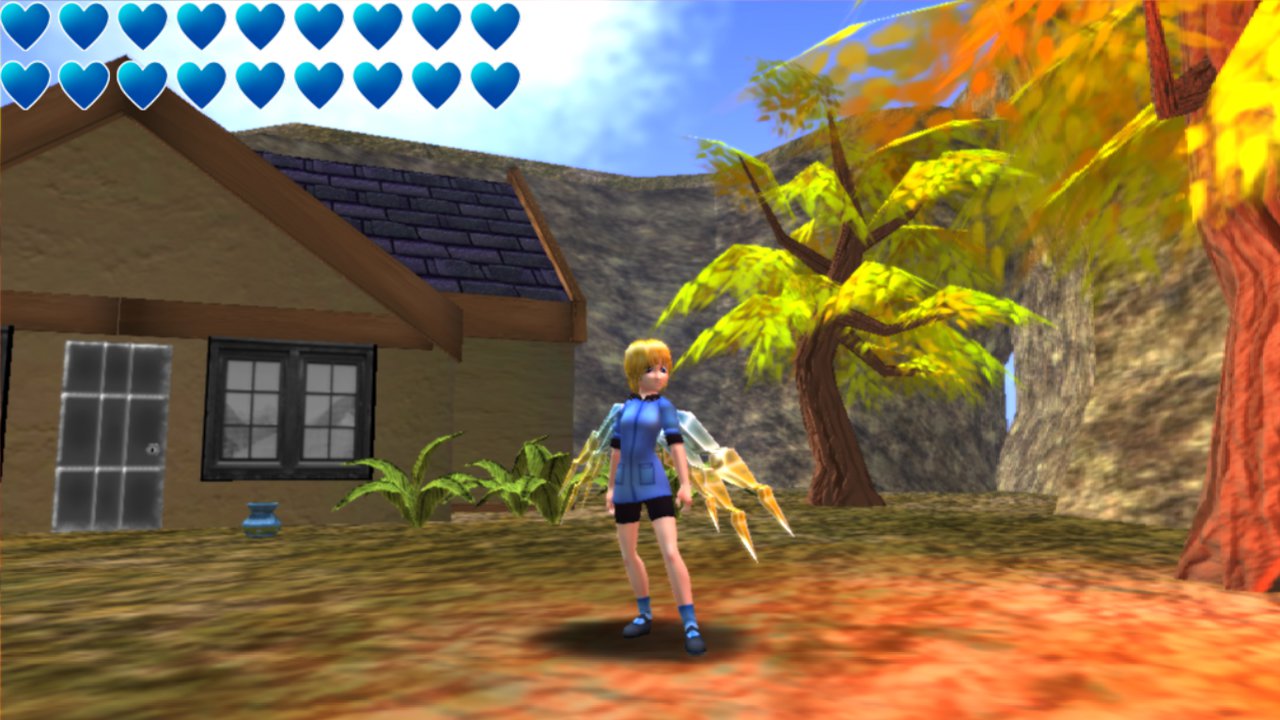
Creators FSS Software touted Steam indie title Glass Wing as a conscious homage to classic Nintendo 64 mainstays like Super Mario 64 and Banjo Kazooie. And on first impressions, the game certainly lives up to that billing.

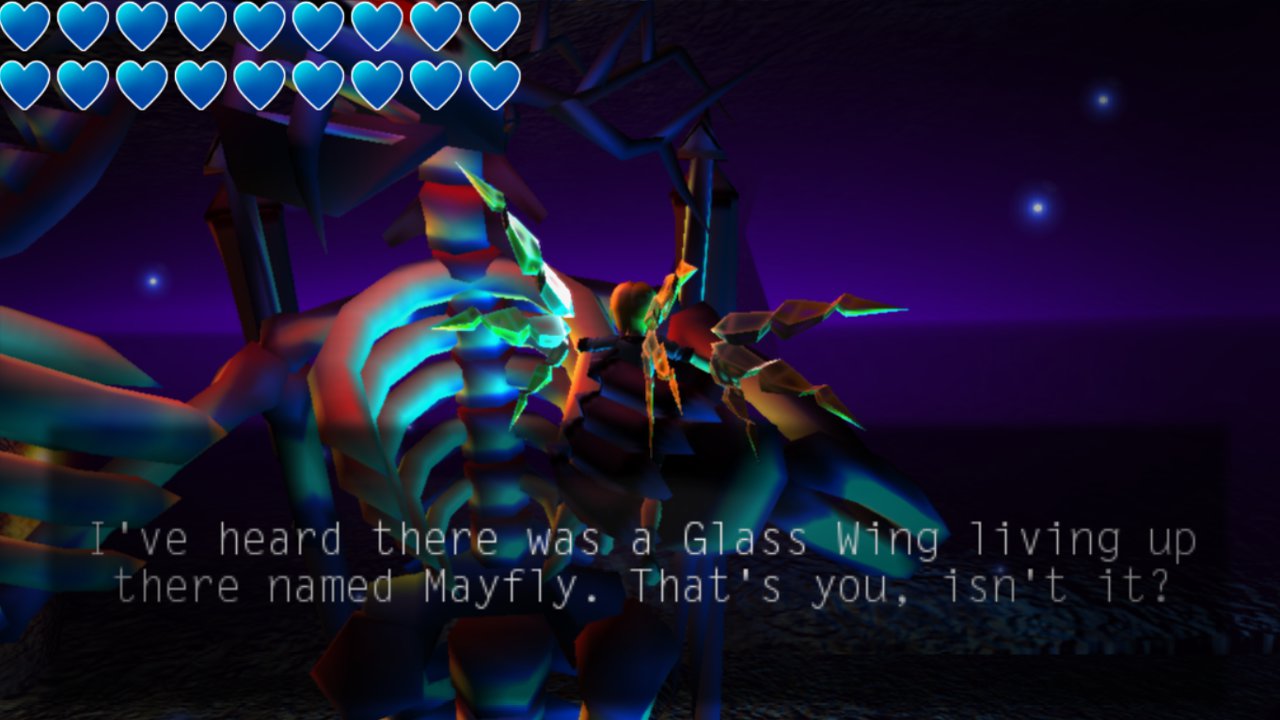
As with many of the N64 adventures, the player finds themselves inhabiting a peaceful, forested fantasy land. Controlling a fairy named Mayfly, it only takes a few minutes of leaping around the green pastures before a demon arrives, kidnaps Mayfly and makes off with her special powers. And so begins the quest to regain her abilities and defeat the bad guy. So far, so Nintendo. With its colourful mix of fairies, monsters and magic, Glass Wing certainly calls to mind the Japanese giant’s more fantastical output of the mid-to-late 1990s.

Glass Wing RPG PC

There’s even the usual 3D platformer pick n’ mix of stage backdrops; stereotypical forest, desert and snow levels are all present and correct. Coupled with familiar visual elements (e.g. warp pipes and Zelda hearts for health), the Nintendo vibe has been well and truly homaged.

Visually, the game sits somewhere between its cited N64 influence and early Dreamcast titles, while a surprisingly adept audio performance rounds out the package. Music-wise it’s a fitting mix of well-produced piano melodies and intense action beats, while the ambient audio cues (those of the enemies in particular) are genuinely effective.

Glass Wing RPG PC

The game itself mostly alternates between Super Mario Sunshine-style platforming void levels and more cerebral Zelda-like environmental puzzling involving item or ability usage. In fact, some of these tasks prove to be quietly ingenious in their implementation, especially for such a no-frills Indie release. The Metroid series also quickly proves to be another clear Nintendo influence with the slow drip feed of accumulated upgrades and abilities.

The game is not without some problems. Camera and control scheme issues plague much of the platforming, a deficiency not helped by the inclusion of an auto-jump feature. Unlike Nintendo’s smooth implementation in Zelda, Mayfly is only too happy to automatically throw herself off ledges and into the void below. Graphics and general presentation are also lacking, although that’s to be somewhat expected for an indie project.

Glass Wing RPG PC

Just like many N64 titles of the era, Glass Wing can be frugal in its dispensing of checkpoints. A possibly deliberate old school design decision, but one that means death often hurtles the player back numerous stages. This, coupled with the clunky controls and aforementioned auto-jump, quickly renders later levels a harsh lesson in abject frustration. A hand-holding modern blockbuster this is not, yet for all the exasperation it’s almost refreshing to return to the challenges of a bygone era. Indeed, the sense of reward upon clearing a particularly white knuckle section almost, almost justifies the preceding frustration.

That’s Glass Wing in a nutshell then; a charming and ambitious indie effort that can infuriate in its idiosyncrasies, but an experience that ultimately leaves a positive impression. Certainly one well worth considering next time it’s spotted in a Steam sale.


Available on Steam, the game’s standard price is £3.99/$4.99/€4.99 and a demo is available.

Glass Wing can be bought through ITCH.IO, where a 125MB free trial can be downloaded and the full-game price is $5.00 (USD).

Filed Under: Games, Reviews Tagged With: Glass Wing, indie, pc, platform, puzzle

Get Social

  • Facebook
  • Instagram
  • LinkedIn
  • Medium
  • Pinterest
  • RSS
  • Twitter
  • YouTube

Top Posts & Pages

  • Total War Adds Dynasty Mode and Chinese Distribution
  • The horrors of Double Dragon on C64: a retrospective
  • Total War Battles: Kingdom Viking Explorers Update
  • The Courteeners @ The Met Lounge, Thursday January 31, 2008
  • Total War: Three Kingdoms Adds Han Warlord Dong Zhuo
  • Best Ever Vanilla Cupcake Recipe
  • Noisia & The Upbeats: Dead Limit EP Review
  • Final Fantasy XII: The Zodiac Age review
  • Dragonball FighterZ full game impressions
  • Heading Beyond the Forbidden Forest once more

Ads

Join Us…

  • Facebook
  • Instagram
  • LinkedIn
  • Medium
  • Pinterest
  • RSS
  • Twitter
  • YouTube


Privacy Policy

Cookie Policy

© 2026 Hot Mod Media · Design & Marketing TWOTW

Disposable Media · FPSPrestige · OnlineRaceDriver · The Guitar List · Rescars · Rescogs

We use cookies to ensure that we give you the best experience on our website. If you continue to use this site we will assume that you are happy with it.