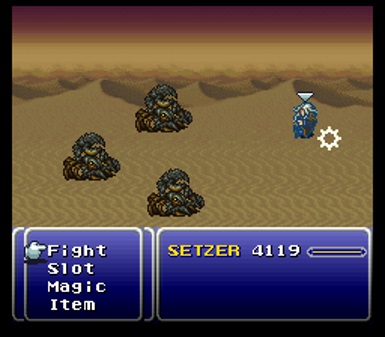
The further back we go, the less I know. I was one of those casual types who barely knew what Final Fantasy was before VII, and ever since then I’ve jumped around the series to see if there was anything else that I missed when I was interested in other games. At least when I think of publishing FFV late impressions, I realise that I kind of had an excuse at the time. It was first released on the SNES (sorry, Super Famicom) in 1992 in Japan, and Europe didn’t get to see it until the 00s and (in the case of PSN and mobile) the 10s. I got around to playing the Game Boy Advance release earlier this year – honestly, it’s not a game that I knew a lot about and so it’s not like I was choosing to play it based on its reputation (unlike my FFVI and Chrono Trigger playthroughs), but I had heard a few good things about it. The game centres around our heroes vowing to restore order after the villain Exdeath shatters the elemental crystals in a bid for power. It’s your typical JRPG format of going from new town to new dungeon, obtaining more abilities and encountering new opponents, culminating in a showdown with the antagonist. Dungeons have some light puzzling and locked-door scenarios, as well as hidden routes to rare treasures – generally, it’s a comfortable RPG template that you can quickly enjoy without being bombarded with too many strange gameplay systems.
FFV late impressions – jobs and abilities

That said, one thing I took away in my FFV late impressions was that the implementation of the job system was more flexible than I expected. I don’t always like job systems in RPGs, because they put a lot of pressure on me to create a sensible range of skills and abilities across my party. I’m not that guy who sets up a team of four white mages, admittedly, but I do feel a certain amount of artificial pressure to “get things right” and not screw myself over in the late game. With FFV’s job system, each job allows a party member to equip certain gear and use special abilities in the battle menu – a thief can steal items from enemies, black and white mages use spells that cause elemental damage or support the party, and so on. However, each party member has a “job” slot and an “ability” slot; after using a job for long enough, the skills associated with that job are unlocked as abilities. This means that you can assign a skill as an ability and then start learning something else in the job slot – creating a summoner who has the thief’s stealing command, or a monk with magic capabilities.
It may seem like a small thing, but it blows open your tactical options – your four party members have their two slots to play with, and at the end of my playthrough I had 21 jobs available as well as the Freelancer (who has two “ability” slots and can wield any gear.) It’s a very different vibe from FFVI (where nearly every character had one “job” throughout the game) and FFVII (where “jobs” are essentially materia and anything goes), but FFV’s own freedoms and restrictions make it satisfying to try different combinations of skills to see what works. By the end of the game (for those curious about the commitment: 38hrs on the clock, with all party members around Lv50), my party was using four different types of magic (blue, black, white, time), controlling enemies (beastmaster), defending against attacks (knight), using summons (summoner) and dealing huge physical damage (with the monk’s “barehanded” ability.) It’s like working with eight party members, but it adds a tactical edge because you still only have four “actions” in your turn.
The grind
The jobs don’t save the game from the usual RPG hurdles, however. I can’t summarise my FFV late impressions without saying that there is still grinding, there are still plenty of random battles, and there are some miserable encounters if you’re not suitably prepared. Towards the end of the game I was being battered by more status ailments than I could deal with in my turns, and so I had to train up someone with time magic to help myself. Also, the random battles can be a nuisance when you’re also finding your way around a dungeon (although gear such as the Chicken Knife – which makes the party auto-flee an encounter and will discharge powerful attacks after fleeing enough battles – make navigation a bit smoother.) As much as I like this game’s jobs and abilities, the later games excel in the moment-to-moment business of dungeon exploration.
FFV late impressions – where to go
In late 2021 Square Enix released the “Pixel Remaster” of Final Fantasy V – I don’t know if it’s a particularly good remaster, but there should at least be options if you’re keen to play this but only have modern hardware. I played the GBA game and it was generally fine, but I have no knowledge of the other versions to compare it against. I don’t know if I’ll look even further back through the series history another time, but I’ve enjoyed this entry. If you have any fond memories of Final Fantasy V, don’t forget to leave a comment below.