This article has been some time in the making. In the 16-bit era, I grew up with the Sega Mega Drive and missed out on a lot of SNES classics. Of course, that didn’t stop me from trying to emulate Final Fantasy VI and attempt to play it on PC, but a busy gaming schedule and a short attention span meant that I never gave it the time it deserved. I did “buy the game” years later via the SNES Classic Mini, but even after making a spirited effort to play it on that machine, I only ended up saving myself into a corner – stranded on the floating continent with an underlevelled party who wouldn’t be able to make it back to the world map. (In hindsight, I may have had a Warp command or item available and didn’t realise, but I’d have to check the save…) Honestly, I didn’t intend to write an FFVI late impressions article in early October because I didn’t know I’d be playing the game; however, I’ve had a pretty quiet gaming schedule and so it’s been a fun way to pass the time.
FFVI late impressions – the old

Final Fantasy VI has some novel and inventive moments, but its foundations are quite old-fashioned. You travel the overworld between towns and dungeons engaging in random battles until you’ve levelled up enough to take out the next thing that’s in your path. Random battles are frequent, and blasting through so much fodder might seem chorelike if I wasn’t already familiar with old-fashioned RPGs. To its credit, the character variety allows battles to remain interesting – each new party member that joins the cause has a unique skill that opens up more tactical options when they’re battling with your party. Early on in the game you might find that a few allies are struggling, but you’ll press on because you’re confident in nailing Sabin’s Blitz techniques, and so he can do a lot of the heavy lifting. Later on you’ll see Setzer’s slot-machine ability (which Cait Sith would later pinch in FFVII) and train yourself in reading the reels and making the most of their benefits. Elsewhere, Cyan has multiple special attacks available if you’re willing to wait before taking action – it’s not the most exciting tactic… but since enemies are still active as you wait, there’s an element of risk. However, not all of the techniques are that amazing – I got a few abilities for Gau on the Veldt but the ones I obtained stopped feeling useful in the later areas. Meanwhile, I think I got all of Mog’s “Dance” techniques, but he was in my tertiary party at the end and so he never got a look in – apologies to Mog fans reading this.
Setbacks
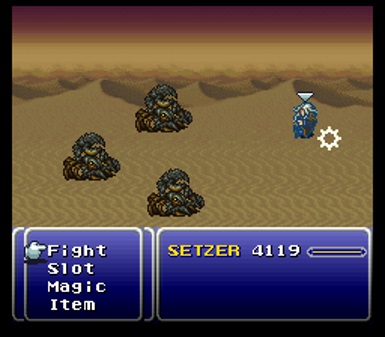
The battles themselves aren’t too bad, but the setbacks can be offputting. After revisiting content that I knew from earlier playthrough attempts, I was playing pretty blind – and so I wasn’t always sure when I’d be underlevelled or overlevelled. I actually ended up using the three available save slots so that I wouldn’t have to go back too far if I was underlevelled. (Although once again, I could have used things like the Warp technique – or the equivalent item – a little more during my playthrough; it essentially whisks the party out of a dungeon safely, and I only really started using it in the final tower area.) One element of modern RPGs that I did miss was the concept of “passive” levelling; where the characters who aren’t in your active party still gain a fair amount of experience. I’ve heard that certain events allow party levels to become “averaged” so that nobody falls behind too much, but I still ended up with a few alarmingly under-levelled characters late in the game, and this became a bit of a problem during certain sequences in the final dungeon that involve your entire party. That said, this is still something that I’m guilty of in modern RPGs – many playthroughs of Persona 4 leave the likes of Kanji and Yosuke laughably underpowered. So whilst I enjoy passive levelling, I’m willing to accept that I could have made better decisions.
FFVI late impressions – perks

Outside of the unique skills, some other fun events can come together that make things more manageable. One particular game changer in this playthrough came from the Economizer relic – I found this as a rare drop from a battle in a north-eastern region of the world map (I think online resources give it the nickname “Dinosaur Forest” or “Dinosaur Island”), and it reduced magic cost to 1MP for one ally. No big deal in the early game… but when used in conjunction with more expensive skills such as Ultima, it made certain encounters a pushover. (Another relic, the Gem Box, allows an ally to perform their action twice during the turn, so they’d spend 2MP and unload Ultima twice. As you can imagine, it got kind of silly.) When modern games are so determined to gate so much of the fun behind busywork and marketplaces, it’s refreshing to find overpowered nonsense that’s fun to use in a game such as this. And of course, this wouldn’t be a series of FFVI late impressions if I didn’t mention the Espers – powerhouses that can be summoned to provide invaluable abilities that help your party in battle… if you’re willing to spend the MP. To be honest, I spent a lot of the endgame using character-specific special techniques and basic magic attacks because Esper abilities always seemed pretty expensive, but I still took the time to unlock skills for the ones I had (The discovery of Ragnarok led to my cheap Ultima double-casting – I also found a shield that granted the same skill to another ally, but it seemed a waste when the Economizer, Gem Box and Ragnarok were so much more efficient) Again, that unlocking could sometimes lead to a bit of a grind, but at least there were world map areas that would make progress a little quicker.
Consequence and character
During my first draft of this article I didn’t really think about mentioning the story or characters too much because it’s all so well-known, but I was impressed by how compelling it all remained. Yes, some of the character traits can feel slightly one-dimensional, and since the post-FFVII explosion of games and spin-offs it’s easy to think that the story might just feel like another Final Fantasy story, but I can appreciate how interesting it would have been at the time. Themes of darkness and chaos exist, but there are still moments of levity and humour that don’t feel too jarring – small-scale silliness such as the recurring encounters with Ultros, and more infamous moments such as the Opera House scene, which manages to be charming, engrossing and funny without feeling like a mess. Also, despite the attention placed on Terra, it doesn’t feel like it’s forcing any one character to be the hero in the way that FFVII pushes Cloud. There’s always the possibility that people will have their favourite party members as the game goes on – whether for story or gameplay reasons – but most of the allies recruited to the cause are likeable enough.
FFVI late impressions – high scores
So where did my party end up during the finale? Most of the characters had levels in the low to mid-50s, with two in the high 50s, two in the 60s and one level 82 character (the Ultima double-caster who was involved in most of the damage-dealing late in the game.) My last save before finishing the game showed a playtime of 42 hours and 49 minutes, which apparently isn’t too bad: the time for “All Styles” on the website HowLongToBeat suggests that a typical playthrough is around 41.5 hours long. (As an aside, I also tweeted my progress when I reached the World of Ruin – back then, most of my party was level 29 or 30, and I had 20.5 hours on the clock… so the two worlds split the game length fairly equally.) I did find the final stretch a bit of a drag even without the perils of under-levelled allies – there’s a lot to do for what often feels like the smallest amount of progress, and whilst random battles quickly become a formality, the party management and navigation of the environment (coupled with occasional long stretches between save points, or long treks back and forth when I wanted to warp to the world map) slowed things down for a while.
Despite all of this, I’ve enjoyed my time with the game, and wouldn’t be averse to revisiting it in the future. If the unique abilities and techniques were all equally interesting, and there was a generous form of “passive” levelling (in addition to the averaging) for other characters, I’d have no trouble recommending it, but even with the caveats it’s not too bad. Outside of my general gameplay impressions, I think that the main characters are all likeable… and there are some fantastic pieces of music throughout the game, from the epic “Decisive Battle” tune that plays during boss encounters, to the moody “Awakening” theme that offers a slower and more intimate variation of the world map music. Since I personally have more history with FFVII, the adventures of Cloud and co. may still mean more to me, but I can definitely see why this is held in such high regard.
Final Fantasy VI was originally released for the Super Nintendo in 1994 – however, ports exist on PS1, GBA, Steam and mobile. You can also find the game on the SNES Classic Mini.