Spoiler warning: don’t read on if you don’t want to know about my experiences with the Sekiro finale and my general impressions of the full game!
I write this a few days after reaching the Sekiro finale… well, a Sekiro finale. A final battle that would wrap the game up and leave me collecting my thoughts as the credits rolled, and then seeing what happened when I was dropped back into the game. I talked about Sekiro briefly in the past, but those were very early impressions – today, I’d like to talk about the boss sequences that made up my Sekiro finale. Specifically, Genichiro, Way of Tomoe and Isshin, the Sword Saint (I understand that there are different endings and potentially different encounters, but many people will encounter these guys.) I’d also like to express my thoughts on the game as a whole having completed this initial playthrough.
Lab training
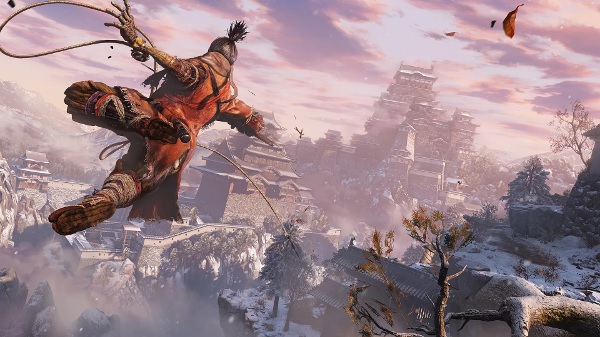
Sekiro is a demanding, punishing and rewarding experience. It demands correct responses to hostile situations, punishes mistakes with ruthless attacks from enemies, and rewards those who persevere enough to avoid making mistakes. It’s also something else – a learning experience. You probably know someone online whose only advice for games like this is to “git gud”, to be in the zone and react to avoid danger rather than learn from mistakes. However, enemy move lists are so varied – and your own options so diverse – that there’s no harm in learning. In a sense, it’s almost like lab training in a fighting game: you get bodied by a setup you’ve never seen before during an online match, and then you go into training mode and try to recreate the situation – how did I get hit by this? What were my options?
Sekiro finale – the rematch

In the Sekiro finale, Genichiro isn’t a new face – you encountered him before at the start of the game – but he’s picked up Mortal Blade abilities. These large swings are hard to avoid and blocking doesn’t do a whole lot, but each Mortal Blade attack has a long startup where Genichiro is in a certain pose. Depending on how he holds the blade, you soon learn which attack is coming; provided you know how to avoid it – run away in one direction or another, circle him – you can prepare accordingly. (Curiously, I saw about three main Mortal Blade attacks when first attempting this boss, but in later attempts I often only saw one. I’m not sure if an update changed probabilities or if I just got lucky, but it was quite interesting.) He also has moves with plenty of cooldown and opportunity to punish (for example, look out for the leaping stab into the ground that he’s kept from the first encounter), so even if you’re bad at deflect timing, you can chip him down until you can work with the posture damage. Despite playing the battle enough to break it down in this way, I still felt that it was enjoyable, and the more you begin to learn the Isshin battle, the more Genichiro’s duel feels like a warm-up.
Sekiro finale – the wall

Meanwhile, Isshin, the Sword Saint is the main event of the Sekiro finale. Packing three phases and a complex movelist, he’s the final exam for players attempting this particular ending path. Once you’ve spent time blocking and countering, you’ll probably wonder if he even lets you get attacks in. If you’re no good at winning the posture war then you’ll want to do damage, but opportunities are few and far between (the cooldown from the “cross-cut” is a reliable punish and is easily spotted when he appears to sheath his sword briefly.) Even so, Isshin is a big fan of three-hit combos of vertical and horizontal swings, and eventually you see these enough times to learn the deflect windows. One other point to note is that it’s easy to act too soon before you know the length of swing combos – figuring out when a combo has ended is a small but vital part of this first phase.
The latter phases, meanwhile, are all about range. Isshin’s long spear means that it’s harder to duel up close, and whilst “wait and bait” is probably frowned upon, it’s still a good idea to start by looking at the new moves and the reach of the attacks. (With his new gun attacks, running away won’t help you a lot anyway.) Even if you do decide to circle him and observe the moveset, an errant thumb movement can lead to death as you start making unsafe tight circles instead of safer wide ones – and if your analogue stick isn’t completely to the left or right when circling, you’re not going to avoid those bullets. Also – much like Genichiro – Isshin has a leaping attack that leaves him vulnerable depending on the pattern; performing a large overhead with the spear, the follow-up where he spins and does a short sword swipe may as well reveal a target on his back. It’s just one hint that the game still gives you openings and opportunities even in its closing duels.
Sekiro – fun, but not flawless
If it weren’t for those small hints at progress – those little opportunities revealing themselves over time – Sekiro would have been shelved weeks ago, with the bosses remaining undefeated. It’s a testament to its design that I never became so frustrated that I walked away. I am still disappointed with the integration of certain gameplay features – things are so much more enjoyable when your options are blown open by grappling points, stealth skills, expendable items and other tools (and not when you’re in a featureless square courtyard with an angry bovine) – but I’ve enjoyed my time with it so far, and I’m sure I’ll be back when I inevitably pick up the Future Press guide.
Apologies to those who expected a full review, but hopefully my existing articles provide some insight into my experience with the game. It’s very punishing and can come across as somewhat limited, but is ultimately quite rewarding. Other From games have felt a little more consistent in their gameplay than this, but that feeling of “lab training” mentioned previously is strangely satisfying. I look forward to discovering what the future has in store in terms of DLC and balance changes.


