Disposable Media

Art, Music, Games, Life

  • Art And Literature
    • Comics
  • Music
  • TV & Film
  • Games
    • Tabletop Games
  • Technology
  • Life
  • Events
  • Magazine Downloads
You are here: Home / Archives for Square

FFV late impressions: the job centre

2nd May 2022 By Qazimod Leave a Comment

The further back we go, the less I know. I was one of those casual types who barely knew what Final Fantasy was before VII, and ever since then I’ve jumped around the series to see if there was anything else that I missed when I was interested in other games. At least when I think of publishing FFV late impressions, I realise that I kind of had an excuse at the time. It was first released on the SNES (sorry, Super Famicom) in 1992 in Japan, and Europe didn’t get to see it until the 00s and (in the case of PSN and mobile) the 10s. I got around to playing the Game Boy Advance release earlier this year – honestly, it’s not a game that I knew a lot about and so it’s not like I was choosing to play it based on its reputation (unlike my FFVI and Chrono Trigger playthroughs), but I had heard a few good things about it. The game centres around our heroes vowing to restore order after the villain Exdeath shatters the elemental crystals in a bid for power. It’s your typical JRPG format of going from new town to new dungeon, obtaining more abilities and encountering new opponents, culminating in a showdown with the antagonist. Dungeons have some light puzzling and locked-door scenarios, as well as hidden routes to rare treasures – generally, it’s a comfortable RPG template that you can quickly enjoy without being bombarded with too many strange gameplay systems.

FFV late impressions – jobs and abilities

That said, one thing I took away in my FFV late impressions was that the implementation of the job system was more flexible than I expected. I don’t always like job systems in RPGs, because they put a lot of pressure on me to create a sensible range of skills and abilities across my party. I’m not that guy who sets up a team of four white mages, admittedly, but I do feel a certain amount of artificial pressure to “get things right” and not screw myself over in the late game. With FFV’s job system, each job allows a party member to equip certain gear and use special abilities in the battle menu – a thief can steal items from enemies, black and white mages use spells that cause elemental damage or support the party, and so on. However, each party member has a “job” slot and an “ability” slot; after using a job for long enough, the skills associated with that job are unlocked as abilities. This means that you can assign a skill as an ability and then start learning something else in the job slot – creating a summoner who has the thief’s stealing command, or a monk with magic capabilities.

It may seem like a small thing, but it blows open your tactical options – your four party members have their two slots to play with, and at the end of my playthrough I had 21 jobs available as well as the Freelancer (who has two “ability” slots and can wield any gear.) It’s a very different vibe from FFVI (where nearly every character had one “job” throughout the game) and FFVII (where “jobs” are essentially materia and anything goes), but FFV’s own freedoms and restrictions make it satisfying to try different combinations of skills to see what works. By the end of the game (for those curious about the commitment: 38hrs on the clock, with all party members around Lv50), my party was using four different types of magic (blue, black, white, time), controlling enemies (beastmaster), defending against attacks (knight), using summons (summoner) and dealing huge physical damage (with the monk’s “barehanded” ability.) It’s like working with eight party members, but it adds a tactical edge because you still only have four “actions” in your turn.

The grind

The jobs don’t save the game from the usual RPG hurdles, however. I can’t summarise my FFV late impressions without saying that there is still grinding, there are still plenty of random battles, and there are some miserable encounters if you’re not suitably prepared. Towards the end of the game I was being battered by more status ailments than I could deal with in my turns, and so I had to train up someone with time magic to help myself. Also, the random battles can be a nuisance when you’re also finding your way around a dungeon (although gear such as the Chicken Knife – which makes the party auto-flee an encounter and will discharge powerful attacks after fleeing enough battles – make navigation a bit smoother.) As much as I like this game’s jobs and abilities, the later games excel in the moment-to-moment business of dungeon exploration.

FFV late impressions – where to go
FFV late impressions

In late 2021 Square Enix released the “Pixel Remaster” of Final Fantasy V – I don’t know if it’s a particularly good remaster, but there should at least be options if you’re keen to play this but only have modern hardware. I played the GBA game and it was generally fine, but I have no knowledge of the other versions to compare it against. I don’t know if I’ll look even further back through the series history another time, but I’ve enjoyed this entry. If you have any fond memories of Final Fantasy V, don’t forget to leave a comment below.
Filed Under: Games Tagged With: ffv, final fantasy, Game Boy Advance, games, GBA, mobile, playstation, PS1, psx, snes, Square, square enix, steam, super nintendo

Chrono Trigger Revisited – a 2021 retro project

8th May 2021 By Qazimod Leave a Comment

Chrono Trigger Revisited? Well, my first visit was cut short in the end. Like Final Fantasy VI (or Final Fantasy III, if you will) this was a game that had been on my list for a while. I was one of the heretics who barely acknowledged JRPGs in the 16-bit era, and we grew up with a Sega Mega Drive rather than a SNES, so I was even more in the dark when it came to FFVI and CT. I’ve been aware of their impact ever since the 1990s, and I think at one point I even had a friend install both games onto a modded Xbox… but I was too distracted by Super Mario World and R-Type III to give Square’s RPGs any attention. Over the years I made a few half-hearted attempts to play through Chrono Trigger, but I often find the time investment for JRPGs somewhat intimidating. Even so, FFVI and CT are two games I’ve always wanted to play through, and I think that finishing FFVI last year motivated me into retrying the other game.

Chrono Trigger Revisited – a series in a single game

Chrono Trigger Revisited

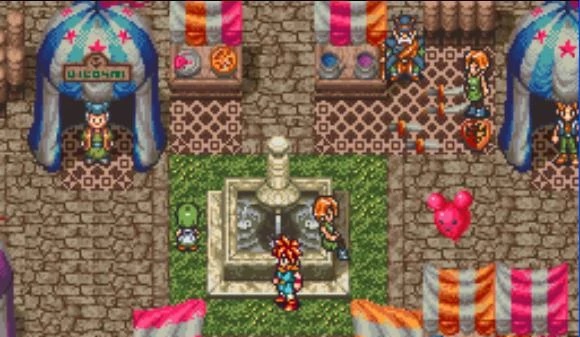
Chrono Trigger settles you in for a classic example of science going too far – as Lucca demonstrates a teleportation device at the Millennial Fair, the pendant of willing volunteer Marle interferes with the device and sends her through a time portal. This sets up the ensuing journey – going through the portal ourselves so that we can find Marle and get back to the present day safely. However, what makes CT so uniquely enjoyable is that this is just the first “quest” for our heroes. Before embarking on Chrono Trigger Revisited, I’m not even sure how much progress I made during my previous attempts… but I found that this wasn’t a simple “rescue the damsel” premise designed to set up the rest of the game. Instead, it was just one of the many adventures our party would have before the credits rolled. Like I said, the time investment needed for old JRPGs can be really off-putting for me, but CT’s structure and format is built in such a way that it feels less like an epic quest and more like around 20-25 “chapters” of an animated adventure series. What this means is that I ended up spending just under 32 hours playing through the game, and throughout that duration it rarely felt like a chore – the story was regularly going to different places, and whenever I spent an evening with the game I felt like I was ending one smaller adventure and beginning another. (Even at the end of the game, you have a series of optional sidequests to perform, but the game is very polite at arranging a to-do list for you; just speak to the old man at the End of Time.)

Chapters and spikes

Admittedly, this is nothing new – most classic JRPGs drop you into one location and establish a miniature quest as part of the main arc – but it lends itself so well to Chrono Trigger. It even extends to a system level as well. Not only are you travelling through time to resolve a problem and then moving on, but each miniature adventure is given its own name in the save files. Each time you save your data the text for the save file displays a chapter name; this is never shown during gameplay, but it has the effect of making your adventures feel self-contained. It’s a simple but effective way of reinforcing a sense of progress. Now, it’s still fair to say that you’ll be spending a lot of time in each of these chapters – there are minigames to complete, and plenty of battles and levelling to be done – but even then, your progress isn’t delayed for long. Over the course of the game your characters learn “techniques” that are your MP-governed skills used in battle, and these can be learned naturally through play or brute forced by grinding in areas – it’s up to you. As you’d expect, MP is only limited by the number of Ethers you can carry, and you’re continually making money as you battle. The game always finds a way to accommodate your time.

These chapters are also prolonged by certain bosses that can feel a bit like difficulty spikes at first, but I don’t think I really spent more than one play session where I was struggling against the same boss. At one point during the “Fated Hour” chapter I was so alarmed by my defeat at the hands of a boss (during the “Black Omen” sequence) that I levelled up my main party around ten times (the area leading up to the boss had lots of battles that rewarded generous levels of experience.) Admittedly, this may have been overkill, because I cruised through most of the rest of the game, but generally the difficulty spikes are few and far between, and you don’t need very many grinding sessions to overcome each obstacle. (Again, spending lots of money on support items – Mid Ethers, Revives – also helps.) At other times, it might feel like the dice rolls simply aren’t going in your favour; you’ll be trying to recover from a boss’ ultimate attack and they’re already charging it again… but perseverance, levelling and preparation helps. (Or if you just want to have more turns available, I found that having someone with the Haste skill was often beneficial.)

Chrono Trigger Revisited – wrapping up

Chrono Trigger Revisited

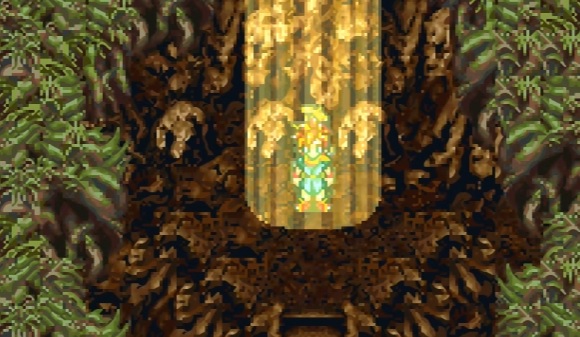
There were a couple of other nitpicks I had during my Chrono Trigger Revisited project – some of the minigames felt a little fiddly (visiting an ice world and avoiding strong wind currents by standing behind rocks sounds fine in theory, but the game is very particular about where you stand), and some exploration sequences had fairly dull gimmicks (guiding Robo through a maze of conveyor belts and switches in order to carry an electric current before it is lost.) However, the rest of the game makes up for these moments. I ended the game with my main character levels at between 67 and 69, and with between 31 and 32 hours on the clock, so it took me fewer hours to complete than FFVI. I’d rather not rate one game over the other, but I feel like CT has a much better structure, whilst FFVI has more potential for silly balance-breaking in a traditional structure. FFVI doesn’t let you tie a bow on a chapter, but it does let you annihilate enemies with Cyan’s Bushido and Sabin’s Blitz techniques, or cast Ultima on foes for 1MP with a relic you found on the world map. That being said, I think that more RPGs can benefit from looking at CT’s tidy, manageable structure. Oh, and both games have pretty great soundtracks – my main standouts in FFVI were the Gestahl Empire theme and the “Awakening” theme… in Chrono Trigger, the Undersea Palace theme stood out as a bold and atmospheric piece that immediately sets the tone in the areas where it’s used.

That’s pretty much all I have to say until my next mammoth retro game undertaking, although this and FFVI were the “big” ones on my personal bucket list. Thanks for indulging me, and let me know in the comments if you have any particularly fond Chrono Trigger memories.

Chrono Trigger was originally released on the Super Nintendo, and re-released through various updates on PSOne, Nintendo DS and Steam.

Filed Under: Games Tagged With: chrono trigger, games, nintendo ds, psone, Square, square enix, steam, super nintendo

FFVI late impressions: notes from a newbie

4th October 2020 By Qazimod 1 Comment

This article has been some time in the making. In the 16-bit era, I grew up with the Sega Mega Drive and missed out on a lot of SNES classics. Of course, that didn’t stop me from trying to emulate Final Fantasy VI and attempt to play it on PC, but a busy gaming schedule and a short attention span meant that I never gave it the time it deserved. I did “buy the game” years later via the SNES Classic Mini, but even after making a spirited effort to play it on that machine, I only ended up saving myself into a corner – stranded on the floating continent with an underlevelled party who wouldn’t be able to make it back to the world map. (In hindsight, I may have had a Warp command or item available and didn’t realise, but I’d have to check the save…) Honestly, I didn’t intend to write an FFVI late impressions article in early October because I didn’t know I’d be playing the game; however, I’ve had a pretty quiet gaming schedule and so it’s been a fun way to pass the time.

FFVI late impressions – the old

FFVI late impressions

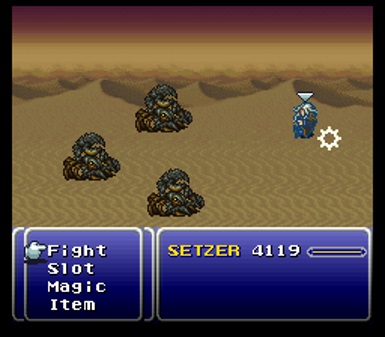
Final Fantasy VI has some novel and inventive moments, but its foundations are quite old-fashioned. You travel the overworld between towns and dungeons engaging in random battles until you’ve levelled up enough to take out the next thing that’s in your path. Random battles are frequent, and blasting through so much fodder might seem chorelike if I wasn’t already familiar with old-fashioned RPGs. To its credit, the character variety allows battles to remain interesting – each new party member that joins the cause has a unique skill that opens up more tactical options when they’re battling with your party. Early on in the game you might find that a few allies are struggling, but you’ll press on because you’re confident in nailing Sabin’s Blitz techniques, and so he can do a lot of the heavy lifting. Later on you’ll see Setzer’s slot-machine ability (which Cait Sith would later pinch in FFVII) and train yourself in reading the reels and making the most of their benefits. Elsewhere, Cyan has multiple special attacks available if you’re willing to wait before taking action – it’s not the most exciting tactic… but since enemies are still active as you wait, there’s an element of risk. However, not all of the techniques are that amazing – I got a few abilities for Gau on the Veldt but the ones I obtained stopped feeling useful in the later areas. Meanwhile, I think I got all of Mog’s “Dance” techniques, but he was in my tertiary party at the end and so he never got a look in – apologies to Mog fans reading this.

Setbacks

FFVI late impressions

The battles themselves aren’t too bad, but the setbacks can be offputting. After revisiting content that I knew from earlier playthrough attempts, I was playing pretty blind – and so I wasn’t always sure when I’d be underlevelled or overlevelled. I actually ended up using the three available save slots so that I wouldn’t have to go back too far if I was underlevelled. (Although once again, I could have used things like the Warp technique – or the equivalent item – a little more during my playthrough; it essentially whisks the party out of a dungeon safely, and I only really started using it in the final tower area.) One element of modern RPGs that I did miss was the concept of “passive” levelling; where the characters who aren’t in your active party still gain a fair amount of experience. I’ve heard that certain events allow party levels to become “averaged” so that nobody falls behind too much, but I still ended up with a few alarmingly under-levelled characters late in the game, and this became a bit of a problem during certain sequences in the final dungeon that involve your entire party. That said, this is still something that I’m guilty of in modern RPGs – many playthroughs of Persona 4 leave the likes of Kanji and Yosuke laughably underpowered. So whilst I enjoy passive levelling, I’m willing to accept that I could have made better decisions.

FFVI late impressions – perks

FFVI late impressions

Outside of the unique skills, some other fun events can come together that make things more manageable. One particular game changer in this playthrough came from the Economizer relic – I found this as a rare drop from a battle in a north-eastern region of the world map (I think online resources give it the nickname “Dinosaur Forest” or “Dinosaur Island”), and it reduced magic cost to 1MP for one ally. No big deal in the early game… but when used in conjunction with more expensive skills such as Ultima, it made certain encounters a pushover. (Another relic, the Gem Box, allows an ally to perform their action twice during the turn, so they’d spend 2MP and unload Ultima twice. As you can imagine, it got kind of silly.) When modern games are so determined to gate so much of the fun behind busywork and marketplaces, it’s refreshing to find overpowered nonsense that’s fun to use in a game such as this. And of course, this wouldn’t be a series of FFVI late impressions if I didn’t mention the Espers – powerhouses that can be summoned to provide invaluable abilities that help your party in battle… if you’re willing to spend the MP. To be honest, I spent a lot of the endgame using character-specific special techniques and basic magic attacks because Esper abilities always seemed pretty expensive, but I still took the time to unlock skills for the ones I had (The discovery of Ragnarok led to my cheap Ultima double-casting – I also found a shield that granted the same skill to another ally, but it seemed a waste when the Economizer, Gem Box and Ragnarok were so much more efficient) Again, that unlocking could sometimes lead to a bit of a grind, but at least there were world map areas that would make progress a little quicker.

Consequence and character

During my first draft of this article I didn’t really think about mentioning the story or characters too much because it’s all so well-known, but I was impressed by how compelling it all remained. Yes, some of the character traits can feel slightly one-dimensional, and since the post-FFVII explosion of games and spin-offs it’s easy to think that the story might just feel like another Final Fantasy story, but I can appreciate how interesting it would have been at the time. Themes of darkness and chaos exist, but there are still moments of levity and humour that don’t feel too jarring – small-scale silliness such as the recurring encounters with Ultros, and more infamous moments such as the Opera House scene, which manages to be charming, engrossing and funny without feeling like a mess. Also, despite the attention placed on Terra, it doesn’t feel like it’s forcing any one character to be the hero in the way that FFVII pushes Cloud. There’s always the possibility that people will have their favourite party members as the game goes on – whether for story or gameplay reasons – but most of the allies recruited to the cause are likeable enough.

FFVI late impressions – high scores

So where did my party end up during the finale? Most of the characters had levels in the low to mid-50s, with two in the high 50s, two in the 60s and one level 82 character (the Ultima double-caster who was involved in most of the damage-dealing late in the game.) My last save before finishing the game showed a playtime of 42 hours and 49 minutes, which apparently isn’t too bad: the time for “All Styles” on the website HowLongToBeat suggests that a typical playthrough is around 41.5 hours long. (As an aside, I also tweeted my progress when I reached the World of Ruin – back then, most of my party was level 29 or 30, and I had 20.5 hours on the clock… so the two worlds split the game length fairly equally.) I did find the final stretch a bit of a drag even without the perils of under-levelled allies – there’s a lot to do for what often feels like the smallest amount of progress, and whilst random battles quickly become a formality, the party management and navigation of the environment (coupled with occasional long stretches between save points, or long treks back and forth when I wanted to warp to the world map) slowed things down for a while.

Despite all of this, I’ve enjoyed my time with the game, and wouldn’t be averse to revisiting it in the future. If the unique abilities and techniques were all equally interesting, and there was a generous form of “passive” levelling (in addition to the averaging) for other characters, I’d have no trouble recommending it, but even with the caveats it’s not too bad. Outside of my general gameplay impressions, I think that the main characters are all likeable… and there are some fantastic pieces of music throughout the game, from the epic “Decisive Battle” tune that plays during boss encounters, to the moody “Awakening” theme that offers a slower and more intimate variation of the world map music. Since I personally have more history with FFVII, the adventures of Cloud and co. may still mean more to me, but I can definitely see why this is held in such high regard.

Final Fantasy VI was originally released for the Super Nintendo in 1994 – however, ports exist on PS1, GBA, Steam and mobile. You can also find the game on the SNES Classic Mini.

Filed Under: Games Tagged With: FFVI, final fantasy, Game Boy Advance, games, GBA, mobile, playstation, PS1, psx, snes, Square, square enix, steam, super nintendo

Final Fantasy XII: The Zodiac Age review

23rd July 2017 By Qazimod Leave a Comment

There’s nothing like a well-timed impulse play – that moment where you’re looking for a way to kill time in a barren release schedule and pick up something in your collection that you never really clicked with, thinking “why not”. In May of last year I played through the original FFXII on PS2 for the first time, remarking on how different it felt when compared to classic FF games, and how interesting the various gameplay systems were. Less than a month later, FFXII: The Zodiac Age was announced – a modern remaster of the original for PS4. And today fans are realising that it’s everything they could have hoped for.

FFXII: The Zodiac Age – still fun

FFXII: The Zodiac Age

More than that, players are realising just how well the gameplay of FFXII holds up. Zodiac Age may boast sharper visuals, better load times and other little tweaks that we’ll get to later, but the core of the exploration and battling remains as it is, because why would you ever need to change it? Gambits may feel like a means to let a game play itself, but FFXII always varied encounters enough to ensure that you could never leave things on autopilot for too long. Even if you’re automatically healing and curing all of the bad things, you still have to be wary of your remaining MP and wait at the mercy of those cooldown timers. At worst the gambits result in less busywork, and at best they allow for multiple situations to be addressed on the fly, as if you have a dozen more pairs of hands that are holding controllers and issuing additional commands. Licences remain as they were – earn points by defeating enemies and use them to buy the “licence” for a magic skill or piece of equipment. However, when you recruit a new character to the party, Zodiac Age now lets you choose from one of twelve licence boards for that character, all categorised into general roles or “jobs”. Do you want a heavy-hitter, someone skilled with bows, a healer? Zodiac Age has a board for everyone.

It allows for a lot of freedom in customisation, and this was a game that already seemed quite customisable before the job system. As I had never played the “International” version of the PS2 game, I went into things slightly blind, but my Knight, Uhlan and White Mage selections comfortably carried the primary team through the game’s opening moments. Whilst my progress through Zodiac Age has been fairly smooth, I am still curious about how much of a risk there is of choosing a bad selection of jobs at the beginning. However, you gain new additions to the party at a steady enough rate to allow for any holes to be filled, and one moment later in the game opens up even more customisation…

FFXII: The Zodiac Age – high speed

FFXII: The Zodiac Age

Weirdly, the addition of the job system might not even feel like the most important change in Zodiac Age, as the experience is transformed with a push of the left shoulder button. This activates High Speed Mode (a feature that I believe was in the PS2 release of International but was hindered by the console performance) – and yes, it literally increases the speed of the action, with animation cycles flying by, allies and enemies ambling around more briskly, and actions being played out much more swiftly. In most other JRPGs, this kind of feature would be pointless as it would be impossible to play at such speeds. However, when gambits are automating the battles, you can hurry through the safe moments and dial things back when you need to do more manual work in the menus. The other controller buttons still work as expected in High Speed mode, so you can still pause the action by bringing up the command list, fixing any issues that gambits have overlooked. Admittedly, this mode is best used in old areas that are deemed “safe”, but it still makes those return visits more bearable.

Also welcome is an autosave feature, which will save the game as you progress through each area. There are very rare moments where an autosave happens moments before failure and there’s no chance of rescuing your team (I think I had one save in a boss room where I was massively underlevelled), but most of the time the saves are in sensible places and can come as a huge relief when you’ve done lots of walking since the last save crystal.

FFXII: The Zodiac Age – the freshness

FFXII: The Zodiac Age

As for the game itself? It’s still Final Fantasy XII; still as good as the game I played in May 2016… still as good as the game originally released in 2006. The story can be a bit corny with some of its drama, and some people might not get on with the real-time/paused-time/gambit nature of combat, but it’s remarkable that the game still feels so fresh after more than a decade. There are still some dodgy character moments and dialogue lines, but it plays like a dream. Too often people roll their eyes at RPG battle systems – random encounters, fiddly menus, no satisfaction… the reasons keep coming. It’s a rare treat to be able to praise the battle system in something like this; a system which only feels so good because of all of the other supporting elements – the gambits, the licences, the jobs. I’ve enjoyed three mammoth JRPGs already this year (Nier, Persona and this) and I’m genuinely pleased to be able to recommend them all – for different reasons, of course – as it’s another reminder that 2017, just like FFXII, is something that keeps on giving.

FFXII: The Zodiac Age is out now for PS4.

Filed Under: Games, Reviews Tagged With: ff12, ffxii, final fantasy 12, final fantasy xii, JRPG, Square, Zodiac Age

Revisiting FFXII in 2016 – a retrospective

14th May 2016 By Qazimod Leave a Comment

Revisiting FFXII wasn’t really something I had been planning, if I’m honest. Squenix’s PS2 JRPG was a game I had owned for several years but never really played for more than a few hours. I had picked it up long after the sixth-generation had finished winding down, and only wanted to own it because I had heard so many good things about it. Apparently it was the best Final Fantasy game since VII, or something, but I have a taste for JRPGs that’s so narrow that revisiting FFXII – or even playing it for the first time – would be a challenge as I didn’t think I’d have the patience to get on with it. Sure enough, many attempts at playing the game left me struggling to keep up with the combination of realtime and paused-time combat, configurable Gambits, licence acquisition and so many other things. It didn’t take long for me to put it back on my shelf and consider revisiting FFXII when I could actually pay enough attention to enjoy it. Fast forward to 2016 and I’ve just completed it for the first time, and naturally I have a few thoughts about the game.

Revisiting FFXII

Revisiting FFXII and the Gambits

Revisiting FFXII was something I postponed for a while because I was so bemused by the gameplay mechanics. Take Gambits, for instance – they were introduced in FFXII and let you automate certain character actions based on given conditions. Rather than bog the player down in conditions and actions or threaten to automate the combat too much, they’re a nice way of streamlining combat and make keeping track of the real-time battles a lot more manageable. For example, you can set up a Gambit that makes a character automatically cast Cure when an ally’s health drops below a certain threshold, or if you have magic that removes a status ailment, you can set up a Gambit that makes a character use that magic when the status ailment is in effect on an ally. You’ll gain a few basic conditions for Gambits early on (setting up conditions where party members attack nearby foes automatically will be one of the first times you’ll touch the Gambit system), but you can buy more at stores and they’re so cheap that it’s often well worth doing. Eventually you get a really good Gambit setup (where elemental weakness are automatically exploited, status ailments are automatically removed, and so on) and the automation is so natural that it becomes surprising when a problem isn’t fixed immediately (e,g. when a new status ailment is introduced that you don’t have a Gambit for yet.) This makes Gambit management a pleasing process of adding and refining conditions as the game goes on.

Revisiting FFXII

Revisiting FFXII and the Licences

Revisiting FFXII also led to me getting to grips with the game’s other big feature: licences. At first I thought the licence board was horribly confusing and made no sense but on my latest playthrough it actually ended up being very rewarding. Winning battles in FFXII rewards you with experience – accumulated in the traditional sense to help characters level up – and licence points. These points are spent in a menu option known as the Licence Board, which sees players select squares on a chequered board to acquire licences for equipment, abilities or other bonuses and unlock further squares for acquisition. You can buy equipment and magic at shops around the game, but until a character has the licence for it, they can’t use it. As a result, you may come across powerful magic or equipment and then see how many squares need to be unlocked to reach the requisite licence – this way you can judge whether it’s worth picking up just yet. It’s a very rewarding system as you get the benefits of gaining access to a new perk *and* you get to see even better perks revealed and teased.

Revisiting FFXII

Revisiting FFXII and the grind

Of course, when revisiting FFXII I also had to bear in mind that this is still a Final Fantasy game and there will be times where you might stumble into a new area hopelessly under-levelled and have to retreat to somewhere that’s easy enough to be manageable but challenging enough to make the experience points worth getting. Even though the battle system is enjoyable enough to avoid feeling like a waste of time, it can sometimes be hard to gauge how levelled-up the game wants you to be at certain points. I believe there are certain licences and accessories that increase experience gains, so the game does offer to make the grind easier, but new areas and bosses can still be a shock to the system at first. The proximity and gambit driven combat at least make battles less of a nuisance than they were in earlier games, but if you’re revisiting FFXII you have to accept that you still need to do a bunch of battling in order to make progress. Personally the only thing that made the actual combat a bit of a chore was the absurd amount of status ailments to keep track of, but by the time they become a problem you’ve probably already bought the necessary magic and gambit conditions.

Revisiting FFXII and the world

Despite all the battling, revisiting FFXII wasn’t harmed by grinding too much because I still had fun exploring the world, going on adventures with my party, getting better gear and unlocking more powerful licences. The town locations are still enjoyable to explore and the dungeons can be intimidating but force you to make the most of your Gambits, actions and equipment. There weren’t really any characters who I thought were annoying or filled with emo angst (the main antagonist felt a bit too “pantomime villain” at times, but that’s to be expected), and any environmental puzzles that arose never outstayed their welcome (I spent too long trying to unlock the right path in the Sochen Cave but that was about it.) And the battling… well most of the time I only died because I hurried through areas, so any bad battles are due to my own impatience. In general, it’s a pretty solid JRPG. If you’re turned off by Final Fantasy games, just try and ignore the name – FFXII has enough unique ideas to be enjoyed irrespective of the series legacy. The only downside now is that you can only play it if you have the original disc, so start your petitions for a HD remake or PS2 classics release…

Filed Under: Games Tagged With: ff12, ffxii, final fantasy 12, final fantasy xii, JRPG, PS2, retrospective, Square

Get Social

  • Facebook
  • Instagram
  • LinkedIn
  • Medium
  • Pinterest
  • RSS
  • Twitter
  • YouTube

Top Posts & Pages

  • Code Shifter revealed by Arc System Works
  • The Upbeats: De-Evolution Part 1 EP Review
  • Soul Calibur 2 Nightmare Statue from First4Figures
  • 2D Vertical Shooter Fast Striker Offers PS4 & Vita Action
  • Noisia & The Upbeats: Dead Limit EP Review
  • Deus Ex Machina 2 (PC)
  • Rocket League 2021 X Games Aspen Limited Edition Items
  • The worth of your entertainment
  • My Disposable 2016 - highlights from this year
  • Dan's Disposable 2025 - Highlights

Ads

Join Us…

  • Facebook
  • Instagram
  • LinkedIn
  • Medium
  • Pinterest
  • RSS
  • Twitter
  • YouTube


Privacy Policy

Cookie Policy

© 2026 Hot Mod Media · Design & Marketing TWOTW

Disposable Media · FPSPrestige · OnlineRaceDriver · The Guitar List · Rescars · Rescogs

We use cookies to ensure that we give you the best experience on our website. If you continue to use this site we will assume that you are happy with it.